#LangGraph multi-agent
429 related articles

·5 min
The Complete Guide to AI Agent Development: A Four-Stage Progressive Roadmap
A systematic guide to AI Agent development across four stages: LLM fundamentals, ReAct paradigm, memory & tools, and multi-agent collaboration for developers.
Read more →
·3 min
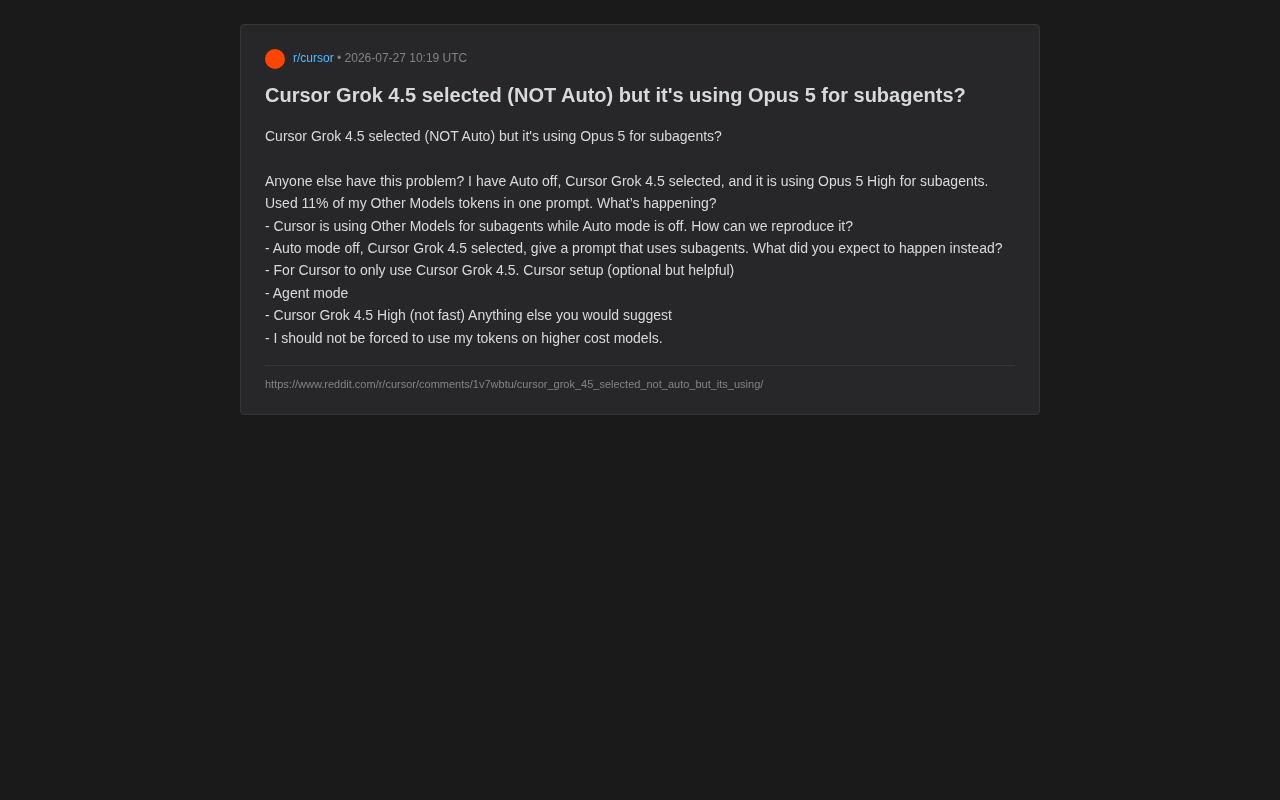
Cursor Selects Grok but Calls Opus: Subagent Model Substitution and Cost Control Issues Explained
Cursor users selecting Grok 4.5 find subagents secretly calling expensive Opus 5, consuming 11% quota per prompt. Analysis of model decoupling, cost transparency, and user strategies.
Read more →

·3 min
Build RAG and AI Agent Projects at Zero Cost: A Practical Guide to Open-Source Tools
Build high-quality AI projects on a budget. Learn how to use Ollama, Groq, Chroma, and other free open-source tools to build RAG systems and multi-Agent workflows from scratch.
Read more →
·3 min
Build RAG and AI Agent Projects at Zero Cost: A Practical Guide to Open-Source Tools
Build high-quality AI projects on a budget. Learn how to use Ollama, Groq, Chroma, and other free open-source tools to build RAG systems and multi-Agent workflows from scratch.
Read more →

·4 min
GenAI Job Interview Gone Wrong: Interviewer Googles Gemini for Questions on the Spot — What's Broken in AI Hiring?
A fresh grad interviewing for a GenAI Trainer role faced prime number coding and activation function questions while the interviewer used Gemini to generate questions live — exposing AI hiring chaos.
Read more →

·4 min
AI Coding Tools in Practice: Which Ones Actually Stuck with the Team?
A 12-person product team shares real-world experiences with Cursor, Codex, Claude Code, and CodeRabbit—exploring efficiency plateaus, scenario matching, and selection criteria for AI coding tools that actually stick.
Read more →

·3 min
Getting Started with AI Agent Development: A Learning Path from Zero to Deployment
A systematic guide to the complete learning path for AI Agent development—covering prompt engineering, RAG knowledge bases, LangChain & LangGraph, fine-tuning, and multi-agent collaboration.
Read more →

·2 min
Getting Started with AI Agent Development: A Complete Guide from Zero to Deployment
A beginner-friendly guide to AI Agent development, covering the full learning path from LLM fundamentals, prompt engineering, and RAG to LangChain and multi-agent collaboration.
Read more →
·2 min
Getting Started with AI Agent Development: A Complete Guide from Zero to Real-World Projects
A beginner-friendly guide to AI Agent development, covering the full learning path from LLM basics, prompt engineering, and RAG to LangChain and multi-agent collaboration.
Read more →

·1 min
Becoming an AI Agent Engineer: A Detailed 4-Week Hands-On Learning Roadmap
Want to become an AI Agent engineer? This article breaks down a 4-week roadmap: from core agent architecture and ReAct, to multi-agent collaboration and real projects.
Read more →

·2 min
Can One Skill Transform All Skills? The Boundary Debate Between Dify Workflows and Agents
A recursive technical proposition: Can we build a "meta-Skill" that auto-transforms any Skill into a Dify workflow? This article dissects the boundary between deterministic orchestration and autonomous Agent decisions.
Read more →

·3 min
Pinterest Medic: Engineering an AI Agent for Automated Spark Failure Diagnosis
How Pinterest engineers built Medic for Apache Spark — a multi-agent auto-diagnosis tool — covering the evolution from a single ReAct agent, observability, log denoising, and end-to-end testing.
Read more →

·3 min
Multi-Agent AI Paper Writing System: A Full-Stack Breakdown of FastAPI + Vue3
A deep dive into an AI paper writing system built with FastAPI + Vue3, covering multi-agent collaboration, RAG, streaming output, and full academic workflow automation.
Read more →

·6 min
The Three-Layer GTM Agent Architecture: Enabling AI to Truly Recognize Buyer Intent and Identity
An in-depth analysis of the three-layer GTM Agent architecture—the Signal, Buyer Intelligence, and Action layers—revealing how context graphs identify anonymous visitors and capture purchase intent.
Read more →

·4 min
Spring AI 1.0 Practical Guide: A Java Developer's Fast Track to Building AI Applications
Spring AI 1.0 is here — Java developers can now build AI apps without switching to Python. This guide covers LLM integration, RAG, intelligent customer service, and Agent patterns for enterprise deployment.
Read more →

·4 min
Java Developer to AI Architect: A Three-Layer Capability Upgrade Roadmap
How can Java engineers transition to AI Architect? This article breaks down three core capability layers — AI app development, production RAG, and AI Agent orchestration — using Spring AI Alibaba and LangChain4j to turn your Java foundation into a competitive edge.
Read more →

·8 min
LangChain Crash Course: A Complete Roadmap from Zero to Agent Development
A systematic roadmap from LangChain and LangGraph to multi-agent development, covering RAG, Tool Calling, MCP, and more, helping developers break into AI app development.
Read more →

·3 min
AI Not Working? Learn to Diagnose Which Layer Is the Problem — Loop, Harness, or Context
AI agents underperforming? The root cause usually isn't the model. This guide breaks down Loop, Harness, and Context Engineering so you can diagnose the real issue fast.
Read more →

·2 min
Getting Started with LangGraph: Graph Orchestration and State Machines for AI Agents
A comprehensive guide to LangGraph's core concepts: Graph API vs Functional API, three-layer architecture, and workflow visualization methods for building AI Agents.
Read more →

·7 min
The Complete Guide to LLM Application Engineer Interviews: Six High-Frequency Agent Topics
A focused guide to core LLM application engineer interview topics, covering agent architecture, Multi-Agent, Langfuse evaluation, security, and RAG optimization.
Read more →