#MLOps monitoring
75 related articles

·3 min
Cekura: A Deep Dive into the Automated Testing, Monitoring, and Self-Healing Closed-Loop Platform for Voice AI Agents
Deep analysis of how Cekura's five-step closed loop—scenario simulation, failure capture, root cause diagnosis, automatic prompt rewriting, and regression verification—solves voice AI agent quality assurance in production.
Read more →

·4 min
Freesolo Flash: Deep Dive into the Full-Stack Platform for Enterprise Small Model Training
Freesolo Flash is a full-stack platform for enterprise small language model (SLM) training that commoditizes reinforcement learning, enabling teams to train specialized AI models at low cost.
Read more →

·3 min
LLMOps Tool Selection Guide: An In-Depth Comparison of Tracing, Evaluation, and Governance Capabilities
In-depth analysis of LLMOps tool selection, comparing Langfuse, LangSmith, Helicone, and Orq.ai across tracing, evaluation, and governance capabilities with practical recommendations.
Read more →

·4 min
Transitioning from DevOps to MLOps: A Complete Learning Roadmap
How can DevOps engineers efficiently transition to MLOps? This guide covers MLOps core concepts, standard workflows, essential tools, and Azure practices with a progressive learning roadmap.
Read more →

·4 min
A Guide to Full-Stack Machine Learning Project Repository Structure: From Chaos to Convention
A detailed guide to organizing full-stack ML project repositories, covering directory structure design, data-code separation, and externalized configuration to help ML developers move from experimental code to production-grade engineering standards.
Read more →

·4 min
Full-Stack Machine Learning Project Repository Structure Guide: From Chaos to Convention
A detailed guide to organizing full-stack ML project repositories, covering directory structure design, data-code separation, and configuration externalization to help ML developers move from experimental code to production-grade engineering.
Read more →

·2 min
Gemini 3.6 Flash Hands-On: Upgrades in Both Quality and Token Efficiency
In-depth analysis of Google Gemini 3.6 Flash's core upgrades including output quality improvements and token consumption optimization, with developer migration advice.
Read more →

·3 min
The Real Daily Life of MLE and MLOps Engineers: Key Differences Between Three Roles and Career Paths
An in-depth look at the real daily work of data scientists, MLEs, and MLOps engineers — covering responsibilities, essential tools, and career paths to help you find your direction in AI.
Read more →
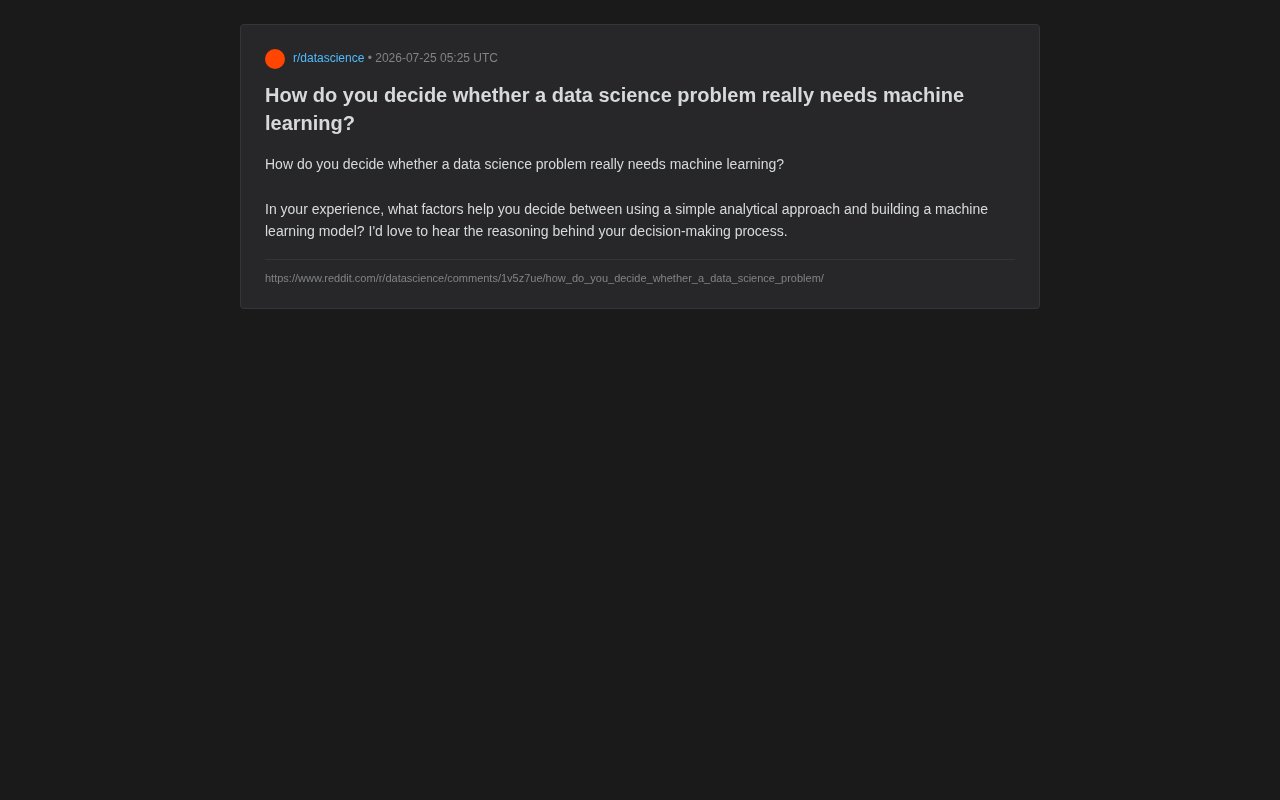
·3 min
When Should You Use Machine Learning? A Pragmatic Decision Guide for Data Scientists
Not every data science problem needs ML. This guide offers a decision framework across four dimensions — rule complexity, data quality, prediction needs, and interpretability — to avoid over-engineering.
Read more →

·3 min
Wattage: An AI Agent Token Cost Profiling and Regression Protection Tool
Deep dive into Wattage, an AI Agent token consumption profiling and cost regression protection tool, exploring its core features, industry context, and value for developers.
Read more →

·2 min
Getting Started with Dify: A Complete Guide to the Open-Source Enterprise AI Application Platform
A complete guide to Dify, the open-source AI application platform: its core positioning, key differences from Coze, workflow-building capabilities, and enterprise private deployment advantages.
Read more →

·7 min
Dify Local Deployment Guide: Full Walkthrough with BT Panel + Docker
A step-by-step guide to locally deploying the Dify open-source AI platform using BT Panel on a VMware virtual machine, covering Ubuntu setup, Docker config, and image pull troubleshooting—beginner-friendly.
Read more →

·7 min
Dify Local Deployment in Practice: A Complete Guide with BT Panel + Docker
A step-by-step guide to locally deploying the open-source Dify AI platform using the BT Panel on a VMware virtual machine—covering Ubuntu setup, Docker config, and image pull troubleshooting.
Read more →

·2 min
Full-Stack Developer to AI Engineer: Which Certifications Actually Matter?
Full-stack developer transitioning to AI/ML? Compare Google, AWS, and Microsoft AI certifications, understand the two career paths, and learn what actually matters.
Read more →

·3 min
Dify Getting Started Guide: A Complete Walkthrough of Low-Code AI App Development
Dify is a low-code AI app platform supporting chatbots, Agents, and workflows. Compatible with DeepSeek, ChatGPT, and more. Learn cloud and local deployment options.
Read more →

·3 min
Dify for Beginners: A Complete Guide to Building AI Applications
A beginner's guide to Dify covering Docker deployment, MySQL setup, model integration, five app types (Chatbot/Agent/Workflow), and publishing — build LLM apps fast.
Read more →

·3 min
Dify Getting Started: A Complete Zero-to-Production Guide for Building AI Applications
A complete guide to Dify — covering deployment, five core app types (chatbot, Agent, workflow, and more), LLM integration, and publishing for zero-experience developers.
Read more →

·3 min
Career Pivot at 47: Midlife Job Anxiety and Redefining Competence in the Age of AI
A 47-year-old engineer who pivoted to data science faces re-employment struggles — a mirror of AI-era anxiety: does using AI count as coding? How to break the midlife career trap?
Read more →

·2 min
Which Coursera Advanced AI Courses Are Worth as Much as an Internship? Top Picks
Can online courses replace internships? We break down the real value of MLOps, Generative AI, and Deep Learning courses on Coursera, plus 3 strategies to get internship-level results.
Read more →

·3 min
MLOps from Scratch: A 100-Day Learning Challenge Roadmap and Practical Guide
A college student's MLOps 100-day challenge documents the full journey from Python engineering and Git to Docker, model deployment, and monitoring. A practical roadmap for data scientists transitioning to ML engineering.
Read more →