#Mac Studio alternative
82 related articles

·4 min
Running Qwen3.6 27B Locally on a Single RTX 3090: A Complete Guide to Cloud-Rivaling Performance
One used RTX 3090, one 16.8GB GGUF file, and Qwen3.6 27B runs locally offline. SWE-bench score of 77 rivals Claude Sonnet. MTP boosts speed to 59 tok/s. Full local AI coding assistant deployment guide.
Read more →
Building an eGPU for Local LLM on a $1…
·2 min
Building an eGPU for Local LLM on a $1,000 Budget: A Practical Buying and Setup Guide
Building an eGPU for local LLMs on a $1,000 budget? This guide covers GPU selection, dock costs, RTX 3090 vs 3060 value, and top tools like Ollama and llama.cpp.
Read more →

·3 min
Jaws at 50: How a Nearly Disastrous Shark Film Created Hollywood's Summer Blockbuster
In 1975, a 28-year-old Spielberg's shark film — plagued by a malfunctioning mechanical shark and 105 days over schedule — became Hollywood's first $100M movie. The full story of Jaws at 50.
Read more →

·3 min
CutWire Prism: A Free, Open-Source Node-Based Live Video Mixer Explained
CutWire Prism is a free, open-source node-based live video mixer supporting multi-source input, chroma key, background removal, Lua scripting, and web remote control. Available for Windows and Linux.
Read more →

·2 min
Local AI Agent Reads arXiv So You Don't Have To: Only the Papers That Actually Matter
Research Radar is an open-source local AI agent that fetches arXiv papers daily, scores and filters them in batches, deep-reads summaries, and pushes truly relevant content via Telegram. Supports local models, keeps data on your machine, free and self-hostable.
Read more →

·4 min
AMD Ryzen AI Halo Hands-On: Can x86 Architecture Challenge NVIDIA's DGX Spark?
In-depth review of the AMD Ryzen AI Halo mini AI box: powered by the Ryzen AI Max Plus 395 (Strix Halo) chip with 128GB unified memory, priced at $4,000. Compared against NVIDIA's DGX Spark across token generation, prefill speed, and x86 advantages.
Read more →

·6 min
Home Self-Hosting Server Setup Guide: Building a Private Cloud Ecosystem from Scratch
One 32GB server, 8 hours to build a complete home self-hosting ecosystem. This article details the selection logic behind core services like Jellyfin, Forgejo, Immich, and Ollama, plus infrastructure setup essentials for Nginx Proxy Manager and Podman Compose.
Read more →

·4 min
AI Coding Tool Data Leakage Risks: A Security Guide for Protecting Quantitative Strategies
AI coding tools carry cloud data transmission risks, exposing quantitative trading strategies to leakage. This article analyzes AI tool data security and offers protection strategies.
Read more →

·5 min
Why Did Ollama Rise So Fast? Decoding the Success of a Local LLM Tool
How did Ollama grow from a niche open-source project into developers' default choice for running local LLMs? This article breaks down its rise across product design, technical strategy, and ecosystem building.
Read more →

·4 min
9 Proven Methods to Make Hermes Agent Actually Work for You
9 battle-tested methods from hundreds of hours with Hermes Agent: model selection (Opus/ChatGPT/GLM), multi-agent failover, cross-device coordination via Tailscale, and reverse prompting workflows.
Read more →

·2 min
GLM-5.2 Spotted in Testing | Claude Fable 5 Launches: 4 Key AI Updates
GLM-5.2 spotted in testing, Anthropic launches Claude Fable 5, Moore Threads open-sources MusaCoder for domestic GPUs, and Google releases Gemini real-time translation.
Read more →

·6 min
AMD Ryzen AI Halo Dev Kit: A $4,000 Local LLM Powerhouse Taking on Apple and NVIDIA
AMD officially unveils the Ryzen AI Halo local AI dev kit, priced around $4,000 with 128GB unified memory, capable of running 70B LLMs locally. An in-depth look at its specs, pricing, and market competition.
Read more →

·6 min
Claude Code Programming from Scratch: A Beginner-Friendly Git Setup Guide for Windows
A beginner-friendly guide to setting up Git on Windows before using Claude Code for AI programming. Covers git.git install, Git for Windows setup, common pitfalls, and verification.
Read more →

·7 min
Electron + LangGraph in Practice: Building an AI Agent Visual Orchestration App from Scratch
A hands-on guide to building an enterprise-grade AI Agent workflow orchestration app with Electron Forge and LangGraph, covering local LLM deployment (Qwen3-0.6B), node-based visual canvas design, and full Function Calling integration.
Read more →
·5 min
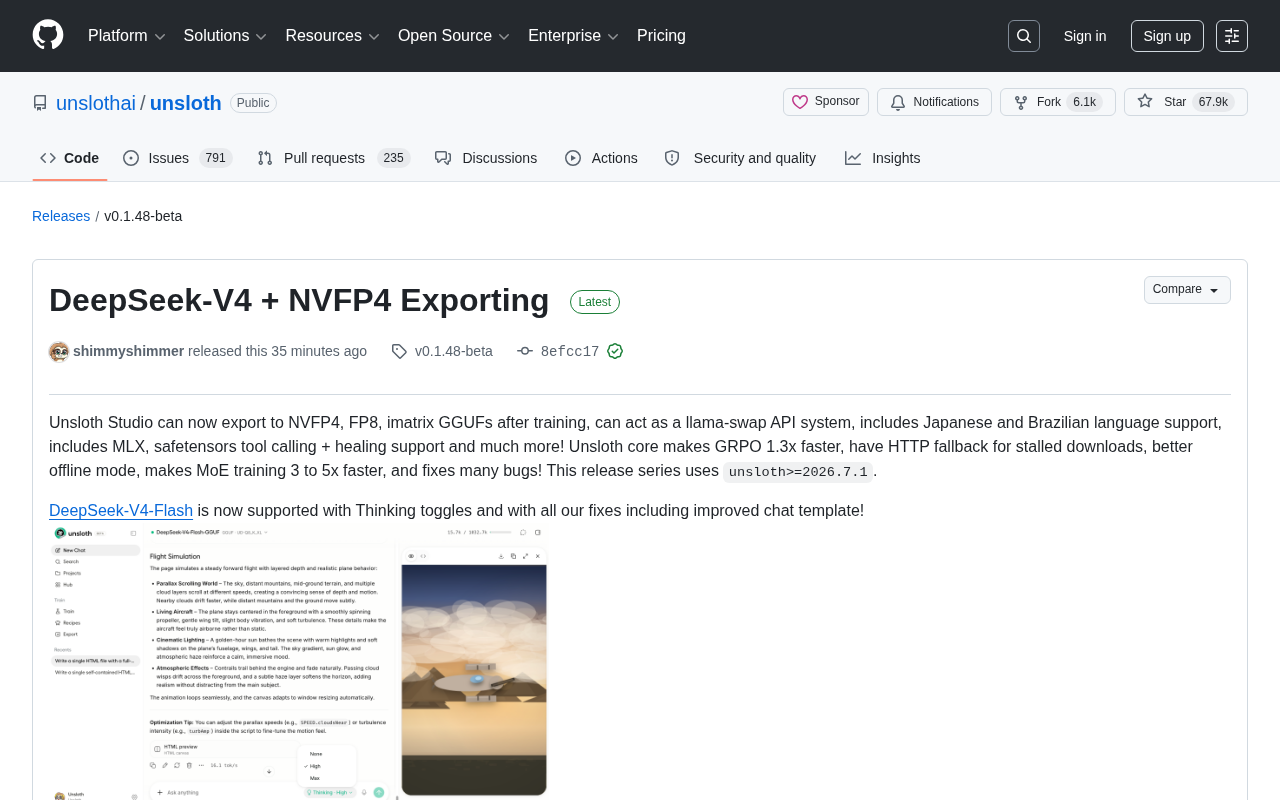
Major Unsloth Update: NVFP4 Quantization Export and DeepSeek-V4 Training Support
Unsloth v0.1.48-beta released, adding NVFP4/FP8 quantization export, OpenAI-compatible API hot-swapping, 3-5x faster MoE training, and 1.3x faster GRPO, covering the full LLM fine-tuning, quantization, and local deployment pipeline.
Read more →

·7 min
Learning Python from Scratch: A Complete Guide to the Three-Stage Learning Path
Want to learn Python from scratch but don't know where to begin? This article breaks down three stages—basic syntax, advanced mastery, and hands-on practice—with real projects in crawling, automation, and data analysis to help you build programming thinking.
Read more →

·3 min
AMD Ryzen AI Halo Local AI Dev Kit Deep Dive: Is $4,000 Worth It?
AMD Ryzen AI Halo dev kit at $4,000 features 128GB unified memory and XDNA 2 NPU for local LLM inference. Deep dive into architecture, performance trade-offs, vs. Mac Studio, and software ecosystem challenges.
Read more →

·5 min
The Attention Bottleneck in AI Coding: Hands-On Agent Workflows from the Father of Crayfish
OpenClaw author Peter shares his thinking on AI coding: when compute is no longer the bottleneck, developer attention becomes the new ceiling. Learn three practical skills—Agent Transcript, Auto-Review, and the Crapbox sandbox.
Read more →

·4 min
12 Open-Source AI Agent Projects Worth Exploring: Frameworks, Skill Packs, and Toolchains
A roundup of 12 trending open-source AI agent projects on GitHub, covering video generation, agent frameworks, skill packs, code engines, security scanning, and voice processing.
Read more →

·6 min
A 284B Model Running on a MacBook: The Real Breakthrough and Barriers of Local DeepSeek Inference
Redis creator runs 284B-parameter DeepSeek model on a MacBook Pro at 26 tokens/sec using a pure C engine, asymmetric quantization, and MoE architecture.
Read more →