#RAG knowledge injection
545 related articles

·3 min
Gemini 3.7 Flash Release and GPT-5.6 Ultra-Fast Mode: AI Open Source Enters the Ecosystem Era
Google releases Gemini 3.7 Flash for coding and Agent optimization while OpenAI launches GPT-5.6 Ultra-Fast mode with 14x speed gains. AI open source shifts from open models to open ecosystems.
Read more →

·5 min
LLM Reasoning Chains Stolen: Deep Dive into Architecture-Level Vulnerabilities Across Three Major AI Providers
Deep analysis of a security paper revealing architecture-level vulnerabilities in Anthropic, OpenAI, and Google's encrypted reasoning chains, covering decryption jailbreak attacks, distillation theft, privacy leaks, and Agent prompt injection.
Read more →

·3 min
ThoughtDAG: Reimagining LLM Conversation Context Management with DAG Graph Structures
ThoughtDAG replaces linear LLM conversations with editable directed acyclic graphs (DAGs), enabling branching, pruning, and merging of context for better AI interactions.
Read more →

·2 min
OpenMontage: A Deep Dive into the Open-Source Agentic Video Production System
Deep dive into the trending GitHub project OpenMontage—the world's first open-source agentic video production system with 12 pipelines, 100+ tools, and 700+ knowledge files.
Read more →

·2 min
Anthropic Open-Sources Agent Skills: A New Era of Modular and Reusable AI Agent Capabilities
Anthropic open-sourced anthropics/skills on GitHub, offering standardized, pluggable AI Agent skill packages. With 160K+ stars, it enables modular agent capability reuse and lowers development barriers.
Read more →

·2 min
Does Whispering to AI Agents in Docs Actually Help? A Practical Guide to Agent Instructions in Documentation
Exploring the real effects and limitations of embedding AI agent instructions in project documentation (like AGENTS.md), from prompt engineering to documentation engineering best practices.
Read more →

·3 min
AI-Powered Vulnerability Discovery in Practice: A Complete Guide to LLM Security Applications
A deep dive into LLM applications in cybersecurity offense and defense, covering AI code auditing, automated vulnerability discovery, CTF Agents, and more, with tool selection guides and compliance guidelines.
Read more →

·5 min
The $60 Billion Cursor Acquisition: Birth and Deep Dive into the AI Programming Operating System
SpaceX acquires Cursor for $60B. How did this AI coding tool evolve from a VS Code fork into a software development operating system? Deep analysis of Agent orchestration, Origin hosting, and model strategy.
Read more →

·4 min
Running Qwen3 27B on a 4090: Q4 Quantization + 128K Context VRAM Calculation & Tuning Guide
Complete guide to deploying Qwen3 27B Q4 quantized model on a single RTX 4090, covering VRAM calculation, K8V4 asymmetric KV Cache quantization, 128K context configuration, and speed analysis.
Read more →

·4 min
Deep Dive into Word Embeddings: The Semantic Foundation of Large Language Models
A detailed explanation of word embedding principles, from one-hot encoding to contextual embeddings, covering embedding matrices, positional encoding, and RAG applications for LLM developers.
Read more →

·3 min
Tencent Open-Sources AI-Infra-Guard: A Deep Dive into the Full-Stack AI Red Teaming Platform
Deep dive into Tencent's open-source AI-Infra-Guard full-stack AI red teaming platform, covering Agent scanning, MCP protocol scanning, LLM jailbreak evaluation, and more.
Read more →
·2 min
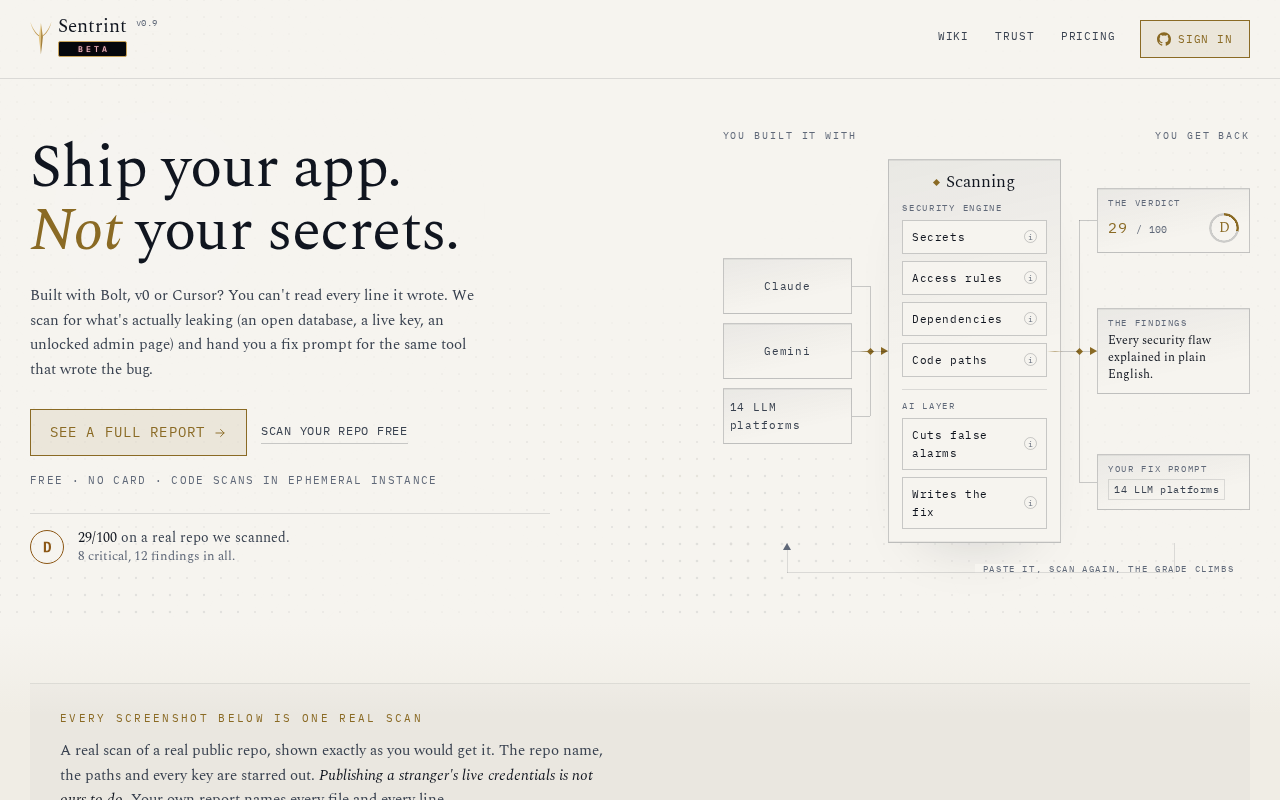
Sentrint: A Security Scanner Built Specifically for AI-Generated Code
Sentrint is a security scanner designed for LLM-generated code, detecting secret leaks, hallucinated dependencies, and injection vulnerabilities in AI code.
Read more →

·3 min
LiteLLM Supply Chain Poisoning Incident: A Deep Dive into 40 Minutes of Full-Stack Credential Theft
Deep analysis of the LiteLLM PyPI supply chain poisoning: how a malicious .pth file silently stole API keys, cloud credentials, and SSH keys in 40 minutes, plus investigation and defense strategies.
Read more →

·4 min
Building AI Agent Skills: 5 Best Practices and Pitfall-Avoidance Guide
Deep dive into 5 core principles for building AI Agent Skills: from description triggers and real experience, to context window optimization, deterministic scripts, and security review.
Read more →

·5 min
AI Agent Development for Absolute Beginners: Complete Knowledge Framework & Learning Path
A systematic guide to AI Agent development covering LLM basics, Prompt Engineering, RAG, LangChain, task automation Agents, and multi-agent collaboration for beginners.
Read more →

·2 min
Vibe Coding Beginner's Guide: A Complete Learning Path to Master AI Programming from Scratch
A deep dive into the Vibe Coding learning path covering Cursor, Claude Code, Codex and more—from foundational AI programming thinking to hands-on projects for complete beginners.
Read more →

·4 min
Can AI Really Find Vulnerabilities While You Sleep and Earn Easy Money? The Truth About SRC Bug Bounties
Deep analysis of the viral "AI autopilot bug hunting for five-figure income" narrative, examining how SRC platforms actually work, AI's real role in vulnerability discovery, and the traffic schemes behind "packaged Skills."
Read more →

·4 min
Getting Started with SRC Bug Bounties: Can You Find Vulnerabilities Without Knowing How to Code?
A beginner's guide to SRC bug bounties: learn how to find business logic, information leakage, and weak credential vulnerabilities using Burp Suite without coding skills.
Read more →

·3 min
RL for Reasoning Only Changes 1-3% of Tokens? The Truth and Controversy Behind the Claimed 1000x Compute Savings
RL training for LLM reasoning only changes 1-3% of output tokens, with researchers claiming 1000x compute savings. We analyze the deep implications, non-uniform token distribution issues, and the gap between benchmarks and real usability.
Read more →

·2 min
Public AI with Shared Memory: What Happens When All Users Share One Brain?
An unconventional AI project lets all users share one memory, sparking debate on privacy, security, and collective intelligence. We analyze its design, risks, and future hybrid architectures.
Read more →