#coding agent setup
572 related articles

·4 min
How Background AI Agents Can Automatically Maintain All Your Repositories on a Schedule
OpenInspect's Multi-Repo Automations lets AI coding agents maintain up to 10 repositories on a schedule simultaneously — isolated sessions, independent PRs, and fault-tolerant execution for security sweeps, dependency upgrades, and framework migrations.
Read more →

·7 min
Complete Guide to Installing and Deploying Claude Code: Configure Your AI Coding Tool from Scratch
A detailed walkthrough of the full Claude Code installation process: environment setup, npm installation, proxy configuration for networks in China, API integration, and CC Switch provider management—helping beginners quickly get started with this AI coding tool.
Read more →

·3 min
OpenAI Codex in the Cloud: Exploring Codebases, Auto-Coding, and Generating PRs End-to-End
A deep dive into OpenAI Codex's cloud workflow: using a Next.js project to demo Ask/Code modes, auto-generating Pull Requests, and locally verifying merges for AI-assisted development.
Read more →

·7 min
Codex Direct Connection Configuration Guide for China: Complete GPT Agent Setup Tutorial
Complete guide for configuring OpenAI Codex Agent in China, covering installation, API key setup, permission modes, reasoning intensity, and security considerations for third-party relay services.
Read more →

·5 min
The Complete OpenCode Tutorial: Installation, Commands, and Advanced Practice
Systematically learn the OpenCode AI programming tool: covering both desktop and WSL installation, core commands, model and rule configuration, MCP integration, and Agent Skills.
Read more →

·4 min
How to Connect DeepSeek to Claude Code: A Complete 4-Step Setup Guide for Users in China
Step-by-step guide to connecting DeepSeek to Claude Code via CC Switch — no VPN needed, start for just ¥10. Covers API Key setup, installation, model config, and a live demo.
Read more →

·3 min
Getting Started with AI Agent Development: A Complete Learning Path to Building Intelligent Applications from Scratch
AI Agents are reshaping software development with 42.8% market CAGR. Learn the difference between Agents and traditional AI, plus a complete LangChain-based curriculum to launch your career in intelligent agent development.
Read more →

·7 min
Gemini Live Integrates Nano Banana: A Complete Guide to Real-Time Camera, Image Generation, and Maps Integration
Google's Gemini Live now integrates the Nano Banana image generation model with Connected Apps like Google Maps, supporting real-time camera scene understanding and visualization. Free worldwide.
Read more →

·5 min
Real-World Comparison of 6 Open-Source LLMs for On-Premise Deployment: A Selection Guide to Avoid Pitfalls
A hands-on comparison of 6 open-source LLMs (DeepSeek, Qwen3, Zhipu GLM, Kimi K2, MiniMax M3, Tencent Hunyuan 3) for on-premise deployment—covering hardware cost, inference efficiency, and deployment difficulty.
Read more →

·3 min
Real-World Test: GPT-4.1 mini Solved a Crash Bug That Stumped Every Chinese LLM
Real debugging case: when 400MB of source code and 40K files caused an infinite crash loop, MiniMax M3, DeepSeek, and Hunyuan all gave wrong answers. GPT-4.1 mini found the root cause after an hour of deep reasoning.
Read more →

·4 min
BingoCode: An Open-Source AI Coding Tool for Offline Deployment — A Claude Code Alternative
BingoCode is an MIT-licensed open-source AI coding tool supporting offline intranet deployment, compatible with DeepSeek, Claude, OpenAI, and Gemini. Pure CLI design, four-step setup, high cache hit rates for lower costs — ideal for security-conscious teams.
Read more →
·6 min
Vibe Coding in Practice at Big Tech: How Frontend Engineers Can Avoid Being Replaced in the AI Era
A big-tech interviewer reveals: junior/mid frontend dev is being replaced by AI. This article breaks down 3 core Vibe Coding interview questions to help you master key skills for the AI-assisted coding era.
Read more →

·4 min
Agent Skills Explained: A Five-Level Evolution from Prompt to AI Expert
A deep dive into Agent Skills: from basic prompts to fully encapsulated AI capability units. Five levels of human-AI interaction evolution, with clear distinctions between Skills, MCP, and Workflow.
Read more →

·3 min
AI-Powered Abaqus Simulation: With vs. Without Skills — The Results Are Worlds Apart
No Skills: AI gets units wrong, assembly fails, zero results. With Skills: AI generates batch stress contour plots end-to-end. A deep dive into the general model + domain skill methodology for AI-driven CAE simulation.
Read more →

·4 min
Complete Guide to Dify Local Deployment: Build a Private AI Workflow Platform from Scratch
Step-by-step guide to deploying Dify locally: Docker setup, Docker Compose installation, source code configuration, .env file setup, and container startup for Windows, macOS, and Linux.
Read more →
·6 min
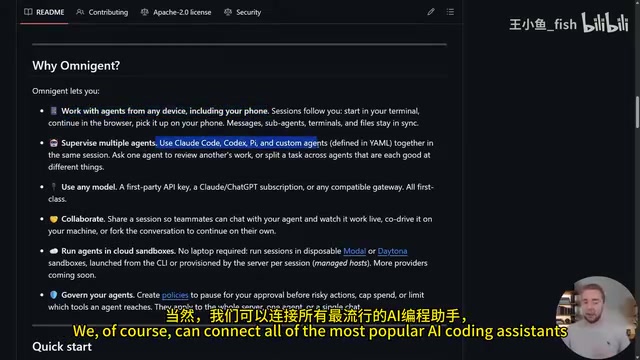
Omnigent Open-Sourced: A Meta-Harness for AI Coding Agents Built by Databricks
Databricks open-sources Omnigent, a Meta-Harness for orchestrating Claude Code, Codex, and more AI coding assistants together—with built-in guardrails, cross-model workflows, and real-time collaboration. Get started in 10 minutes.
Read more →

·7 min
Getting Started with LangChain: The Core Framework Connecting LLMs and AI Applications
A deep dive into LangChain's positioning and value—why do LLMs need a middle layer? How does LangChain serve as the 'glue' unifying multi-model interfaces and supporting Agent development? Learn its core modules and learning path.
Read more →

·7 min
Harness Engineering: The Six-Layer Engineering Framework for Enterprise AI Agent Deployment
From Prompt Engineering to Harness Engineering, a deep dive into the core challenge of truly deploying AI Agents in enterprises. This article breaks down the six-layer architecture and shares real-world Hermes Agent practice.
Read more →

·3 min
Getting Started with Codex: A Deep Dive Comparison of AI Coding Agents vs. Claude Code
A deep dive into AI coding agents like Codex and Claude Code — real-world comparisons, MCP protocol explained, and how these tools are transforming programming for developers and beginners alike.
Read more →

·5 min
OSWorld 2.0 Benchmark: Top AI Agent Achieves Only 20% Completion Rate — Long-Horizon Tasks Are the Achilles' Heel
OSWorld 2.0 benchmark tests 108 long-horizon computer tasks. Claude Opus tops at only 20.6% completion, exposing critical AI weaknesses in state tracking and error self-correction.
Read more →