#local LLM observability
196 related articles

·3 min
Vessel: A Local LLM Observability Proxy for Request Capture and Cross-Model Replay Comparison
Vessel is a free, open-source local LLM observability proxy supporting Ollama, LM Studio, and more. Capture requests, track tokens, replay across models, with built-in MCP server and Web UI.
Read more →

·3 min
Agent Observability: Why Traditional Monitoring Falls Short and Practical Solutions
Explore why traditional monitoring (latency, drift, accuracy) fails for AI agents, and learn practical solutions using LangFuse, LangSmith, and OpenTelemetry.
Read more →
·3 min
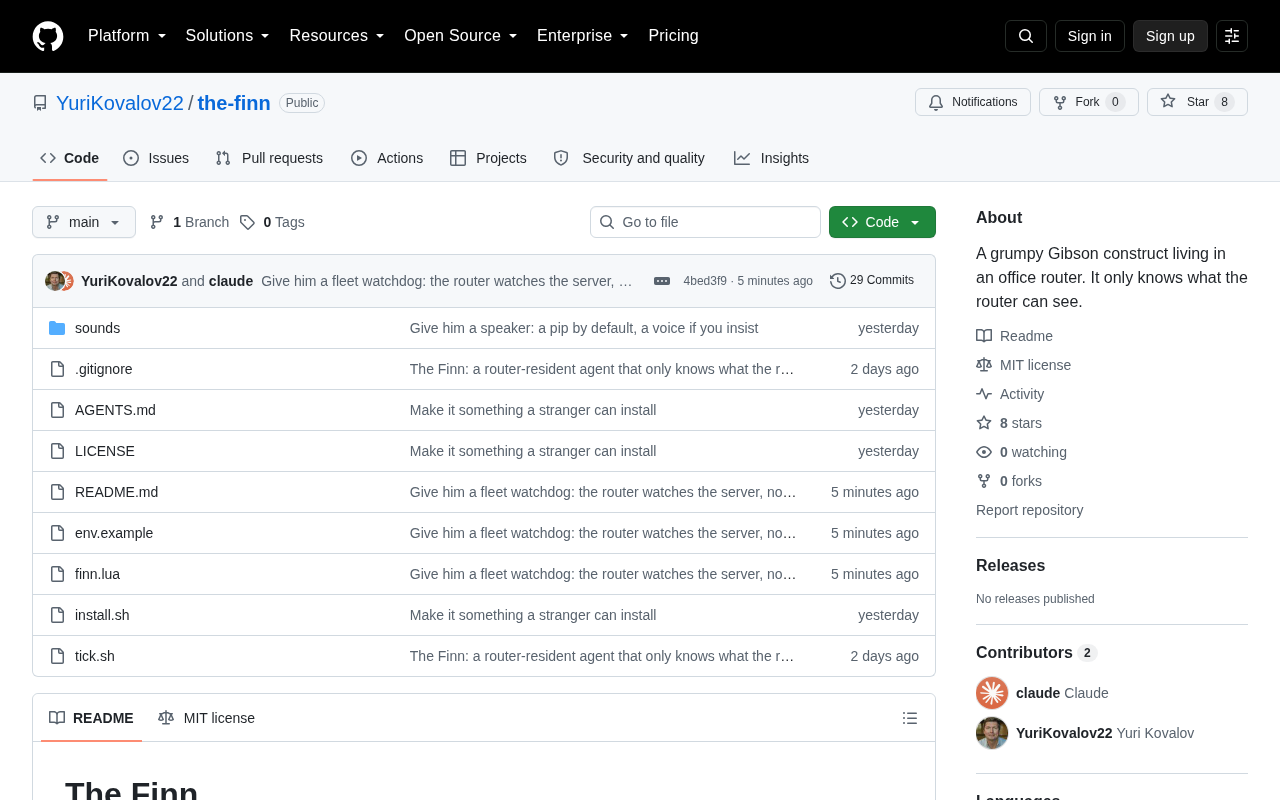
The Finn: An AI Agent Deployed on a Router That Won't Stop Complaining
The Finn is an open-source project that deploys a complaining AI agent on a router. We break down its edge AI deployment challenges, persona design philosophy, and what it means for local AI agents.
Read more →

·4 min
LangGraph Multi-Agent Routing: Production-Grade Orchestrator-Worker Architecture Design
Deep dive into LangGraph Orchestrator-Worker architecture: task DAG planning, checkpoint_ns state isolation, interrupt management, and production best practices for multi-agent systems.
Read more →

·3 min
A Guide to Optimizing LLM Tail Latency: Request Hedging and Other Low-Cost Fixes Explained
Learn how to fix LLM tail latency (P99/P99.9) using request hedging, dynamic timeouts, and scheduling optimizations — practical low-cost solutions for production LLM apps.
Read more →
·2 min
Warren: Isolated Runtime Infrastructure Built for AI Coding Agents
Warren is an open-source infrastructure project providing isolated workspaces, resource limits, real-time observability, and Git delivery for AI coding agents running securely in your own environment.
Read more →

·2 min
The Complete Guide to AI Agent Development: From Core Principles to Enterprise-Level Implementation
A deep dive into the core tech stack and practical path for AI Agent development, covering Agent principles, LangChain, MCP, multi-agent collaboration, with hands-on Vue project demos and a four-stage learning roadmap.
Read more →

·4 min
Reinforcement Learning for Suspended Payload Yaw Control: Principles, Challenges, and Implementation Strategies
An in-depth exploration of RL-based suspended payload yaw control, covering underactuated system challenges, RL advantages and limitations, and PPO/SAC implementation strategies for Sim-to-Real transfer.
Read more →

·4 min
LangChain MCP Integration in Practice: From Concepts to Building Multi-Tool AI Applications
Complete guide to integrating LangChain with MCP protocol, covering Agent principles, MCP Server/Client communication, tool reuse, and framework decoupling for building multi-tool AI applications.
Read more →

·3 min
DeepSeek Harness Hands-On Review: A Transparent AI Coding Framework Where Everything Is a Plugin
Hands-on review of DeepSeek Harness developer preview: its everything-is-a-plugin architecture, fully transparent tracing, Creator Mode for conversational plugin development, and flexible multi-model support.
Read more →

·3 min
Self-Hosted LLM Tech Stack: A Complete Guide to Managing Your Local AI Cluster from the Terminal
A deep dive into self-hosting LLM tech stacks: inference engines, model management, vector databases, and how to manage your local AI cluster from the terminal.
Read more →

·2 min
Apache Maka: An Auditable, Local-First AI Agent Workspace
Deep dive into Apache Maka, a local-first AI Agent workspace built on append-only logs. Explore its architecture, privacy-first design, and unique value for production AI Agent deployment.
Read more →

·3 min
Gemini 3.7 Flash Release and GPT-5.6 Ultra-Fast Mode: AI Open Source Enters the Ecosystem Era
Google releases Gemini 3.7 Flash for coding and Agent optimization while OpenAI launches GPT-5.6 Ultra-Fast mode with 14x speed gains. AI open source shifts from open models to open ecosystems.
Read more →

·3 min
DeepSeek Harness Hands-On Review: A Detailed Guide to the Agent Scaffolding Tool for Developers
Hands-on review of DeepSeek Harness (DSH): analyzing private model integration, plugin architecture, four conversation modes, and more to help developers understand this Agent scaffolding tool.
Read more →

·4 min
Qwen3 27B + DeepSeek Harness Real-World Testing: Local Open-Source Agent Performance Evaluation
Real-world testing of Qwen3 27B with DeepSeek Harness agent framework: deployment setup, visual understanding, reasoning intensity comparison, and token consumption data across multimodal tasks.
Read more →

·3 min
DeepSeek Harness Deep Dive: The 'Everything Is a Plugin' Paradigm for AI Programming
DeepSeek's open-source Harness framework, built on Cordis Kernel, uses an 'everything is a plugin' design for ultimate customization. Supports multi-model integration, built-in traceability, and Creator mode self-extension.
Read more →

·3 min
Zero-Cost Agentic RAG Architecture: Why the LLM Is Your Least Reliable Node
Deep dive into an Agentic RAG system achieving 99.9% uptime on a free 512MB container, covering keep-alive design, hybrid parsing routing, circuit breakers, and confidence gating patterns.
Read more →

·5 min
AI Agent Development for Absolute Beginners: Complete Knowledge Framework & Learning Path
A systematic guide to AI Agent development covering LLM basics, Prompt Engineering, RAG, LangChain, task automation Agents, and multi-agent collaboration for beginners.
Read more →

·4 min
How Should New Graduates Choose a Technical Specialization? Starting from ML Engineering Practice
How should new graduates choose a technical specialization in the AI era? Analyzing the gap between model callers and builders, Kubernetes experience transfer, C++/CUDA learning paths, and the value of deep specialization.
Read more →

·3 min
LangChain + MCP in Practice: A Beginner's Guide to Agent Tool Integration
A detailed guide to LangChain, Agent, and MCP protocol concepts — learn how standardized tool-calling protocols solve model-switching fragmentation and help build maintainable AI apps.
Read more →