#multi-agent coding
744 related articles

·3 min
Long Documents Don't Work: Why AI Agents Can't Follow Your Rules
Analysis of why AI Agents can't reliably follow long policy documents, covering context dilution, rule conflicts, and soft constraint limitations, with more reliable governance architectures.
Read more →

·2 min
agent-manager: An Open-Source Tool for Managing Multiple AI Coding Assistants with tmux
agent-manager is a lightweight tmux-based TUI tool that helps developers manage multiple AI coding assistants like Claude Code, Codex, and OpenCode from a unified interface for status monitoring, interaction, and code review.
Read more →

·3 min
Implementing Zanzibar in Lean4: A Formally Verified Permission Engine for AI Projects
Deep dive into a Datalog permission DSL built on Google Zanzibar using Lean4 theorem prover. How formal verification strengthens AI permission management.
Read more →

·4 min
Getting Started with Claude Code: Environment Setup, Common Commands, and Git Workflow in Practice
A detailed guide to Claude Code installation, domestic model switching, project analysis commands, and Git workflow practice to help developers quickly master this AI programming collaboration tool.
Read more →

·5 min
July 24 AI Daily Brief: Flux 3 Multimodal Release, Kimi K3 Lags in Testing, Qwen Tops TTS Rankings
July 24 AI news: Black Forest Labs launches Flux 3 multimodal model, Kimi K3 lags in US-UK gov tests, Alibaba Qwen tops TTS rankings, Etched raises $300M, AMD unveils MI430X.
Read more →

·5 min
Loop Engineering Explained: The New Programming Paradigm Where AI Prompts Itself
Loop Engineering is a paradigm shift in AI usage. Learn how to build automated loops where agents explore, execute, and verify tasks autonomously, with a hands-on e-commerce case study.
Read more →

·3 min
Learning AI Large Language Models: A Complete Roadmap from Beginner to Practitioner
A systematic breakdown of the AI LLM learning roadmap covering prompt engineering, AI Agent development, RAG knowledge bases, model fine-tuning, and hands-on projects for beginners.
Read more →

·5 min
Learn AI Agent Development from Scratch: A 3-Step Practical Path to Get Started Quickly
How to learn AI Agent development from scratch? This article outlines a clear 3-step path: Python crash course, LLM theory & practice, and LangChain framework project implementation.
Read more →

·3 min
How AI Agents Are Reshaping Enterprise Work: From Task Automation to Organizational Restructuring
Explore how AI agents are redefining enterprise work—from applied AI partnerships and multi-agent collaboration to structural workflow redesign and organizational transformation.
Read more →

·5 min
Running GPT-5.6 Inside Claude Code: Best Practices for Subagent Orchestration and System Prompts
Deep dive into running OpenAI GPT-5.6 inside Claude Code: comparing Codex vs Claude Code on subagent orchestration, workflow design, and system prompt quality, revealing how harness engineering determines model output.
Read more →

·3 min
A Beginner's Guide to AI Agents: Two Learning Paths for Developers and Practitioners
How to learn AI Agents from scratch? This guide covers two clear paths: developers go from Python to LLMs to open-source framework source code; practitioners use Claude Code or similar tools to get results fast.
Read more →

·4 min
A Beginner's Guide to AI Agents: Core Principles and Learning Paths Explained
Learn AI Agent core principles from scratch: understand how Agents differ from LLMs, their execution mechanisms, why rule design matters, and find the right learning path for your goals.
Read more →

·3 min
Deconstructing Agents: Task Decomposition, Context Compression, and the Case Against Heavy Frameworks
A deep engineering analysis of Agent internals: how LLMs decompose tasks via tool calling, why context compression and memory are essential, and why solo developers should avoid heavy frameworks.
Read more →
·4 min
A Beginner's Guide to AI Agents: Core Principles and Learning Paths Explained
A beginner's guide to AI Agents: understand core principles, how Agents differ from LLMs, their execution mechanisms, and get tailored learning path recommendations.
Read more →

·5 min
Complete Breakdown of Core Competencies for AI Agent Engineers: From Demo to Production-Grade Systems
Deep breakdown of 4 core AI Agent engineer competencies: business decomposition, multi-Agent architecture, quantitative evaluation, and engineering delivery—bridging the gap from Demo to production.
Read more →
·3 min
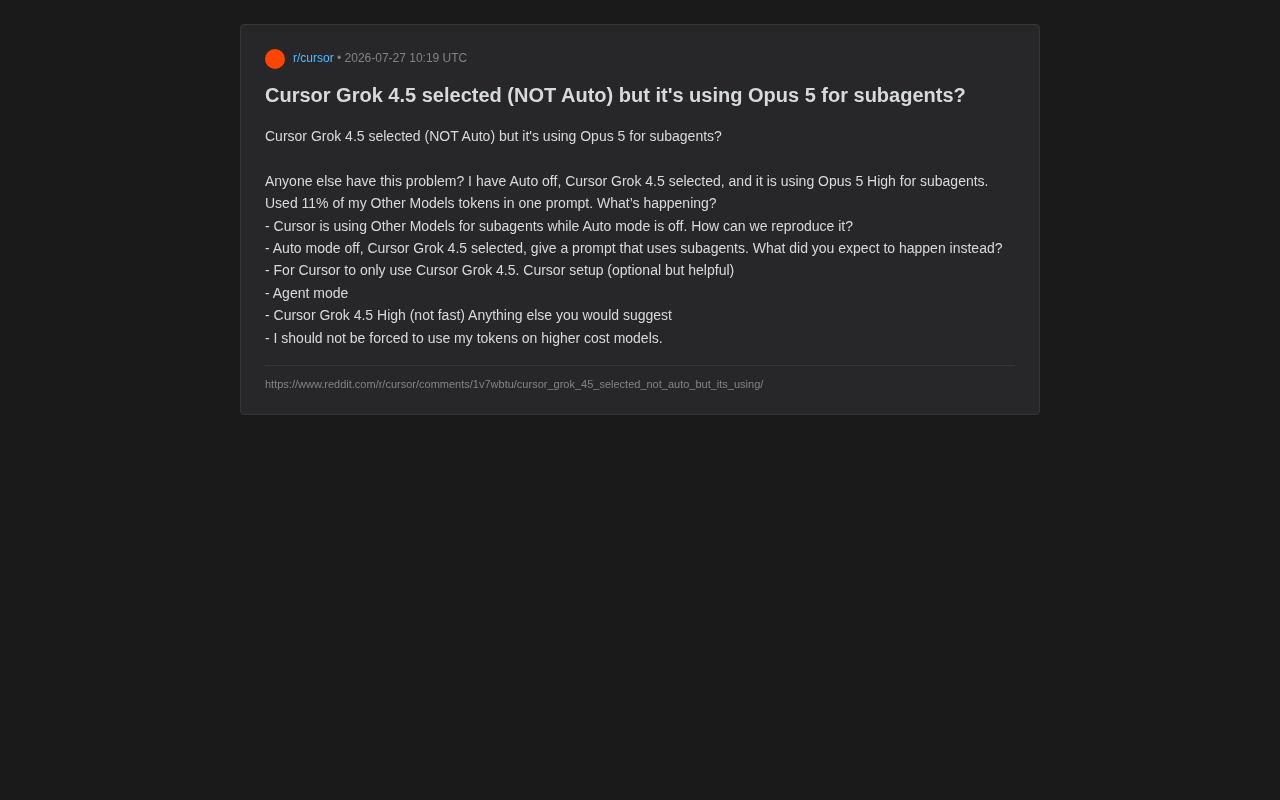
Cursor Selects Grok but Calls Opus: Subagent Model Substitution and Cost Control Issues Explained
Cursor users selecting Grok 4.5 find subagents secretly calling expensive Opus 5, consuming 11% quota per prompt. Analysis of model decoupling, cost transparency, and user strategies.
Read more →

·4 min
The More Complex the AI Agent, the More It Hallucinates? The Hidden Cost of Architectural Complexity
Why do AI Agents hallucinate more as they grow more complex? This article analyzes the causes from error accumulation, context noise, and model completion nature, with 5 practical production strategies.
Read more →

·4 min
Claude Code Tutorial: Environment Setup, Command Reference & Git Workflow in Practice
Complete guide to Claude Code covering CLI installation, domestic model switching, core commands, Git automation workflows, and automated code review and fix loops for enterprise projects.
Read more →

·4 min
GenAI Job Interview Gone Wrong: Interviewer Googles Gemini for Questions on the Spot — What's Broken in AI Hiring?
A fresh grad interviewing for a GenAI Trainer role faced prime number coding and activation function questions while the interviewer used Gemini to generate questions live — exposing AI hiring chaos.
Read more →

·4 min
AI Coding Tools in Practice: Which Ones Actually Stuck with the Team?
A 12-person product team shares real-world experiences with Cursor, Codex, Claude Code, and CodeRabbit—exploring efficiency plateaus, scenario matching, and selection criteria for AI coding tools that actually stick.
Read more →