#ChatGPT desktop
217 related articles

·4 min
OpenAI Merges Codex and ChatGPT: Deep Dive into Three New Models + Agent Workflows
OpenAI merges Codex and ChatGPT into a unified platform while launching three new models: SOUL, TERRA, and LUNA. Deep dive into Computer Use, loop workflows, multi-threading, and the Agent Native strategy.
Read more →

·4 min
Complete Guide: Connecting DeepSeek and Other Chinese LLMs to Codex
No ChatGPT account? No problem. Learn how to connect DeepSeek and other Chinese LLMs to Codex using the Codex++ management tool — including Base URL setup, API Key creation, and token top-up.
Read more →

·3 min
OpenAI Releases GPT-5.6 and ChatGPT Work: The Era of Autonomous AI Has Arrived
OpenAI launches GPT-5.6 (Sol, Terra, Luna), ChatGPT Work, a new desktop app, and Sites hosting. AI evolves from a Q&A tool into an autonomous work partner for finance, file management, and more.
Read more →
·3 min
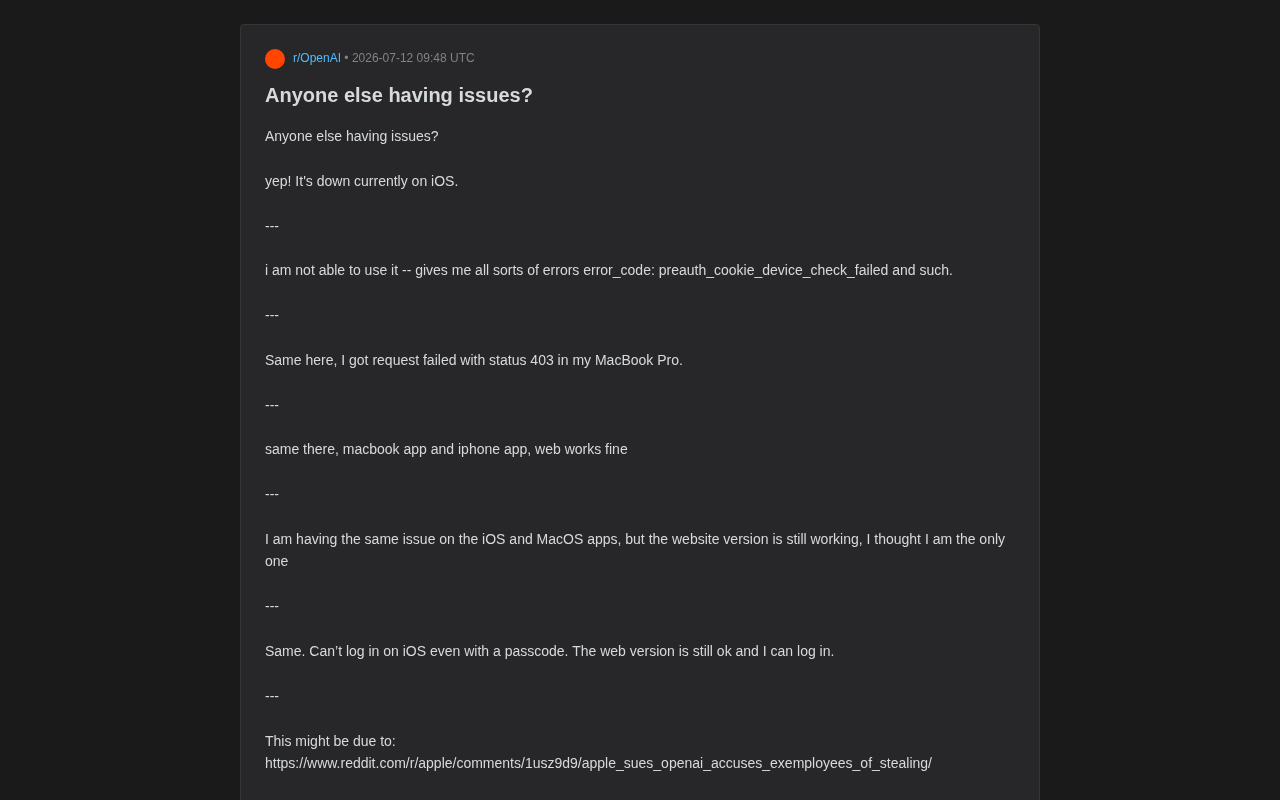
ChatGPT Client Widespread Outage: Why the App Fails While the Web Version Works
ChatGPT's iOS and macOS clients suffered a global outage with preauth_cookie_device_check_failed and 403 errors, while the web version worked fine. Here's why.
Read more →
ChatGPT Work Deep Dive: The Cloud-Loca…
·3 min
ChatGPT Work Deep Dive: The Cloud-Local Split and What It Means for Users
ChatGPT Work runs in the cloud on web/mobile but accesses local files on desktop — and they don't sync. A deep dive into the split design, UX tradeoffs, and broader AI agent challenges.
Read more →

·3 min
GPT-5.6 Released: How Multi-Agent Workflows Are Ending the Chat Box Era
OpenAI releases GPT-5.6 with Sol, Terra, and Luna models plus ChatGPT Work execution environment, shifting AI from chatbots to autonomous multi-agent workflows that directly operate local files and business systems.
Read more →

·3 min
Codex Beginner's Guide: A Step-by-Step AI Work Assistant Tutorial for Non-Coders
Complete beginner's guide to OpenAI Codex desktop client: installation, setup, project management, and plugins — no coding required. Let AI actually do work for you.
Read more →

·8 min
LangChain Crash Course: A Complete Roadmap from Zero to Agent Development
A systematic roadmap from LangChain and LangGraph to multi-agent development, covering RAG, Tool Calling, MCP, and more, helping developers break into AI app development.
Read more →

·2 min
Hermes Agent: A Complete Beginner's Guide to the Self-Evolving Open-Source AI Agent
Hermes Agent is an open-source autonomous AI Agent with long-term memory and self-evolution. Learn its core innovations, how it compares to Open Cloud, and why it hit 121K GitHub stars.
Read more →

·2 min
GPT-5.6 Sol Tops Frontend Leaderboard · Claude Code Gets Built-in Browser · 50-Year Math Conjecture Solved
GPT-5.6 Sol tops Chatbot Arena's frontend leaderboard, Claude Code gains a built-in browser, Sol Ultra proves a 50-year math conjecture, and Gemma 4 gets 5x faster.
Read more →

·6 min
The Complete Codex Guide: From Beginner to Pro with the All-in-One AI Assistant
OpenAI Codex is more than a coding tool—it's an AI agent that writes code, makes slides, and operates browsers. This guide covers its four versions, permission modes, plugins, automation, and six best practices.
Read more →

·6 min
GPT-5.6 Hands-On Deep Dive: Three-Tier Models + Ultra Multi-Agent, Codex Fully Evolved
OpenAI launches GPT-5.6 with three tiered models—Sol, Terra, and Luna—Ultra multi-agent parallel collaboration, Codex integrated into ChatGPT desktop, and an upgraded Computer Use.
Read more →

·3 min
Dify Getting Started: A Complete Zero-to-Production Guide for Building AI Applications
A complete guide to Dify — covering deployment, five core app types (chatbot, Agent, workflow, and more), LLM integration, and publishing for zero-experience developers.
Read more →

·3 min
Coze Deep Dive: A Complete Guide to the Agent Building Platform vs. Dify
A deep dive into ByteDance's Coze platform: tool categories, positioning vs. Dify, skill store, multi-agent collaboration, and workflow building — your AI Agent selection guide.
Read more →

·5 min
The Complete Claude Code Guide: Installation, Core Features, and Advanced Workflows
An in-depth guide to Anthropic's Claude Code agentic coding tool, covering installation, pricing plans, model selection, token management, CLAUDE.md global memory, MCP integration, Subagents, and more.
Read more →

·2 min
Codex vs Claude Code: Which Should Beginners Choose?
One month using both Codex and Claude Code: a real-world comparison across model capability, Chinese UI, usage limits, and ecosystem interoperability for beginners.
Read more →

·4 min
Codex Major Upgrade: GPT-5.6 Powers Full-Stack Development from Idea to Deployment
OpenAI Codex gets a major upgrade with GPT-5.6: extended reasoning, multi-agent parallelism, browser control, one-click Sites deployment, task orchestration, and mobile dev support.
Read more →

·2 min
Qwen Complete Review: Full Breakdown of the Free ChatGPT Alternative
Hands-on Qwen review: Alibaba's free AI platform offers image generation, video creation, web dev, voice/video chat & travel planning — rivaling ChatGPT Plus.
Read more →

·3 min
GPT 5.6 Deep Dive Review: The Most Capable Model Yet — But Also the Most Confusing to Use?
GPT 5.6 brings major capability upgrades and new SOUL/TERRA/LUNA tiers — but also confusing entry points, hidden quota consumption, and a chat window crammed into a floating widget. A deep-dive review.
Read more →

·2 min
ROS2 for Beginners: The Essential Framework for Robot Development
A complete introduction to ROS2 for beginners: what ROS is, how ROS1 and ROS2 differ, and how to choose the right version to kickstart your robot development journey.
Read more →