#LangChain
1370 related articles
·7 min
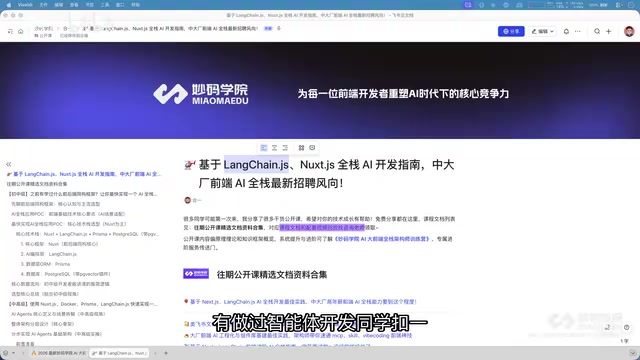
LangChain.js + Nuxt.js: An AI Full-Stack Advancement Path for Frontend Engineers
Frontend hiring now treats AI capabilities as a core assessment, covering RAG knowledge bases, AI Agent development, and LangChain.js engineering. Learn how LangChain.js + Nuxt.js helps frontend developers build memory- and retrieval-capable AI full-stack apps.
Read more →

·6 min
Getting Started with LangChain: Unified Interfaces and Agent Development Explained
A beginner's guide to the LangChain open-source framework: explaining how to use the init_chat_model unified interface, tips for disabling DeepSeek's thinking mode, and core essentials of Agent development.
Read more →

·6 min
LangChain Open-Sources OpenWiki: Automatically Generate and Maintain AI-Readable Wikis for Your Codebase
LangChain open-sources OpenWiki, a tool that auto-generates and maintains AI-readable wiki documentation for codebases via a single command, powered by Git history and agents.md integration.
Read more →

·6 min
LangChain 1.0 Comprehensive Guide: Three Core Frameworks and Hands-On AI Application Development
Deep dive into LangChain 1.0's architecture: LangChain framework, LangGraph multi-Agent orchestration, and LangSmith observability platform, with hands-on RAG and intelligent customer service projects.
Read more →

·7 min
Andrew Ng Teams Up with LangChain: Core Principles of LangGraph Agent Development
Andrew Ng and LangChain CEO Harrison Chase present AI Agents in LangGraph, covering five core agent design patterns and LangGraph's graph-based framework for building cyclical agentic workflows.
Read more →
·7 min
Andrew Ng Teams Up with LangChain: Core Concepts of LangGraph Agent Development
Andrew Ng and LangChain CEO Harrison Chase's AI Agents in LangGraph course covers five agent design patterns and LangGraph's graph-based framework for building cyclical AI workflows.
Read more →

·6 min
LangChain + MCP in Practice: A Pitfall-Avoidance Guide to LLM Selection and Local Deployment
DeepSeek R1 lacks Function Calling and JSON Output by default. Qwen3's programmable thinking modes make it the top open-source agent choice. Key LLM selection pitfalls and MCP protocol updates.
Read more →

·4 min
Frontend to Full-Stack AI: A Complete NestJS + LangChain Roadmap
Pure frontend roles are shrinking fast. Learn how mastering NestJS and LangChain AI agent development can unlock a 20–30% salary boost on your full-stack AI transition path.
Read more →

·6 min
Getting Started with LangChain: A Deep Dive into Model and Agent Core Concepts
Deep dive into LangChain's core Model and Agent concepts, covering unified model interfaces, agent tool calling, middleware mechanisms, and key principles for building LLM applications.
Read more →

·3 min
Java AI Framework Comparison: A Selection Guide for Spring AI, LangChain4J, and More
In-depth comparison of four Java AI frameworks — Spring AI, LangChain4J, DJL, and JBot AI — covering features, use cases, and ecosystem compatibility to guide your selection.
Read more →

·2 min
Spring AI vs LangChain4j: A Comprehensive Comparison of Java AI Frameworks
In-depth comparison of Spring AI and LangChain4j covering ecosystem integration, features, usability, RAG, Tools, MCP, and Agents to help Java developers choose the right AI framework.
Read more →

·4 min
Spring AI vs LangChain4j: How to Choose a Java AI Framework
In-depth comparison of Spring AI and LangChain4j — two major Java AI frameworks — covering core features, completeness, ecosystem support, and usability to help Java developers make the right choice.
Read more →

·2 min
LangChain + MCP Agent Development: A Practical Guide to LLM Selection and Common Pitfalls
A deep dive into LLM selection for LangChain and MCP agent development, comparing DeepSeek V3/R1 vs Qwen3 on Function Calling and MCP support with practical tips.
Read more →

·3 min
Complete Guide to LangChain 0.3: Module Architecture & Core Development in Practice
A deep dive into LangChain 0.3's module architecture, message abstraction, prompt templates, output parsers, LCEL chains, LangSmith tracing, and LangGraph for mastering LLM application development.
Read more →

·2 min
Deep Agents: Key Topics from the LangChain Chicago Meetup Explained
LangChain's Chicago Meetup spotlights Deep Agents — exploring the evolution from simple Agents to multi-layered reasoning and long-chain task execution.
Read more →
·3 min
LangChain Beginner's Guide: From Environment Setup to RAG — A Complete Hands-On Walkthrough
A systematic guide to LangChain covering environment setup, model invocation, Prompt Templates, Output Parsers, LCEL chain expressions, and hands-on RAG implementation for beginners.
Read more →

·4 min
LangChain4j in Practice: A Complete Tutorial for Building a RAG Medical Q&A System
A complete tutorial on building a RAG medical Q&A system with LangChain4j, covering Ollama local deployment, Redis vector DB, document vectorization, and Cursor AI-assisted development.
Read more →

·3 min
Deep Dive into LangChain's Social Media Agent Open-Source Project: Architecture, Features, and Practical Value
In-depth analysis of LangChain's open-source social-media-agent: content sourcing, AI curation, scheduled publishing, Human-in-the-Loop design, and LangGraph architecture.
Read more →

·3 min
NestJS + LangChain: A Practical Guide for Frontend Engineers Transitioning to AI Full-Stack Architecture
How can frontend engineers transition to AI full-stack? This guide covers NestJS + LangChain, TypeScript fundamentals, AI Agent development, local model deployment, and cross-language architecture skills.
Read more →

·3 min
LangGraph Core Explained: Its Relationship with LangChain and Multi-Agent Orchestration Principles
Deep dive into LangGraph's core positioning, its relationship with LangChain, practical code comparisons of Chain vs Graph, understanding Agent essentials, and multi-agent orchestration design.
Read more →