#RAG
287 related articles

Sieve and Sage: Teaching Retrieval-Augmented Models to Know What They Don't Know
arXiv paper proposes Sieve and Sage framework for RALMs, using a two-stage pipeline to enable reliable abstention — boosting accuracy by up to 69.4 pts and speed by 1.99×.

Retrieval Is a Decision Problem, Not a Similarity Problem: Lessons from GPT Researcher Experiments
Retrieval isn't just similarity matching — it's a decision problem. GPT Researcher experiments show decision-based retrieval raises relevant context from 46% to 73%, reshaping RAG and AI Agent design.

Open-Source Intelligent Business Data Assistant: A Deep Dive into the RAG+MCP+RBAC Memory-Driven Architecture
An open-source memory-driven BI assistant combining RAG, MCP tool protocol, and RBAC built on FastAPI + React — featuring persistent analytical memory, knowledge grounding, evidence-backed answers, and enterprise security.

Enterprise AI Customer Service in Practice: Building a Full Pipeline with RAG + Agent + Ontology + Human Review
A full walkthrough of building enterprise AI customer service: how Agent orchestration, RAG retrieval, Ontology relationship queries, and human review work together across order lookup, knowledge search, auto-reply, and exception escalation.

Where Does Your RAG Pipeline Actually Break: Retrieval or Generation?
When your RAG pipeline underperforms, is it retrieval or generation at fault? This guide breaks down failure patterns, diagnostic methods, and layered evaluation strategies for both stages.

AI Agent Memory Optimization in Practice: Moving Beyond Context Window Stuffing
How should you design an efficient memory system for AI Agents? A developer shares their journey from context stuffing to persistent memory layers, comparing vector RAG, graph-based, and metadata filtering approaches to cut Token costs and boost speed.

How to Choose a High-Quality AI Agent Development Course: 5 Practical Screening Criteria
How do you avoid wasting money on low-quality AI Agent courses? Here are 5 practical screening criteria: full delivery pipeline, resume-worthy projects, real engineering perspective, update frequency, and mentorship support.

Corrective RAG (CRAG) in Practice: Building a Compliance Research Assistant That Self-Validates
How does CRAG make a compliance assistant self-check before answering? A deep dive into a LangGraph + Qdrant self-correcting RAG Agent with document scoring, query rewriting, and bounded retries.

Running RAG on 8GB RAM with Frequent OOM? A Practical Guide to Optimizing Docling's Memory Usage for PDF Processing
Running Docling on 8GB RAM and hitting OOM while building RAG? Learn batching strategies, Docling memory optimization, and how to decouple local testing from AWS deployment.

How RAG Systems Handle Dynamic State, Temporal Data, and Conflicting Records
How do RAG systems handle dynamic state, temporal data, and conflicting records in production? Explore metadata filtering, versioning, bitemporal modeling, conflict resolution, and GraphRAG strategies.

Qwen3 + RAGFlow: A Zero-Cost Guide to Building a Local Knowledge Base from Scratch
Step-by-step guide to building a local knowledge base AI assistant using Ollama, Qwen3, and RAGFlow at zero cost — covering Docker setup, model integration, vector retrieval, and hallucination elimination.
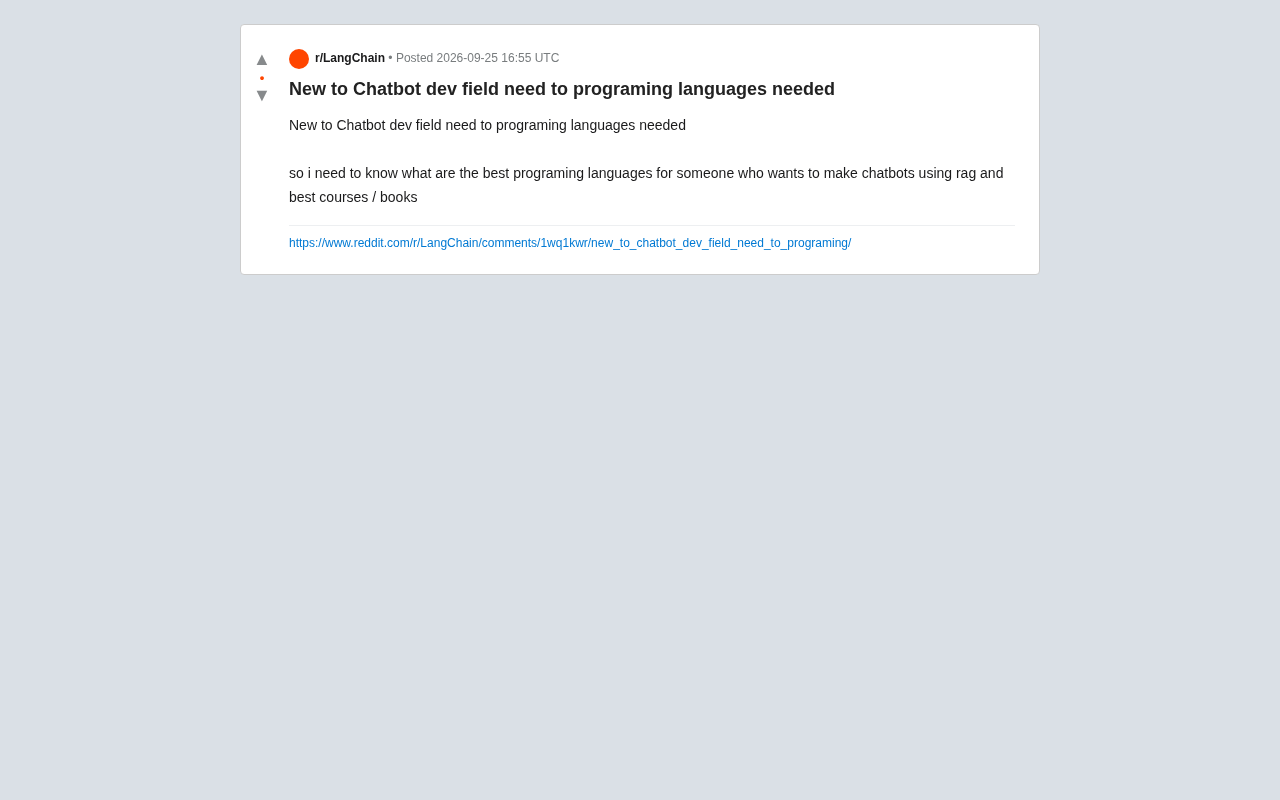
Getting Started with Chatbot Development: Which Programming Languages Do You Need for a RAG Stack?
Not sure where to start building a RAG chatbot? This guide covers language selection (Python, JavaScript), the core RAG workflow, and beginner-friendly learning resources.

Embedding Models in RAG Explained: From Knowledge Base Construction to Similarity Retrieval
A deep dive into how Embedding models power RAG: from chunking knowledge bases and storing vectors, to retrieving top-k documents and assembling prompts — and why fine-tuning Embeddings is key.

The Hidden Risks of Context Optimization: Who Tests the Evidence You Throw Away?
Context optimization isn't just about compression. This article examines the hidden risks of LLM context pruning — how critical discarded evidence gets masked by average metrics — and explores Reef Infra's experiment loop, selection policies, and coverage testing approaches.

Why LangChain Is Essential for LLM Applications: A Guide to Core Concepts
Why learn LangChain if you can already call LLM APIs? This article explains LangChain's core value from an engineering perspective, covering Prompt Templates, Chains, Memory, RAG, and Agents.

DeepSeek + RAGFlow: A Complete Guide to Building a Local Personal Knowledge Base
Step-by-step guide to building a local personal knowledge base with Ollama, DeepSeek, and RAGFlow — covering RAG, Embedding, Docker setup, and online model options.

Spring AI 2.0 in Practice: Building an AI-Powered OA System with Cursor
A deep dive into a Spring AI 2.0-powered enterprise OA system featuring RAG retrieval, AI smart forms, LLM tool calling, and multi-level approvals — built with Cursor AI.

Deep Dive into RAG Systems: Why Enterprise Private Knowledge Bases Are Harder Than You Think
RAG looks simple but hides real complexity. This article breaks down enterprise RAG: PDF chunking, BGE-M3 embeddings, multi-path retrieval, re-ranking, Agent routing, and RAGAS evaluation.

AdaMem: A Soft Compression Method That Intelligently Allocates Memory Tokens by Relevance in RAG
AdaMem is a relevance-guided RAG soft compression framework that dynamically allocates memory tokens by query relevance. Outperforms uniform baselines across 6 QA benchmarks with up to 19.7% relative gain at 64× compression and 4× lower latency.

Open-Source Document Intelligence in Practice: RAG-Based PDF Q&A with Multi-Model Switching
A developer open-sourced a RAG-based document Q&A platform supporting PDF/DOCX upload, pgvector retrieval, and single-config switching between OpenAI and Claude. A deep dive into its stack and design.