#React
2281 related articles
 Product Reviews
·1 min
DeepSeek V4 Deep Dive: Three Core Technologies That Comprehensively Surpass GPT-4.0 in Coding
DeepSeek V4 technical deep dive: million-token context window, N-gram memory architecture, and MHC manifold-constrained hyperconnections surpass Claude and GPT-4.0 in coding at one-tenth the cost.
Read more →
 Tutorials
·2 min
Guide to Building a DeepSeek V4 + Claude Code Hybrid Programming Workflow
Learn how to combine DeepSeek V4 with Claude Code to build a cost-effective AI programming workflow. Covers setup, task layering, and real demos—cutting AI coding costs by 76%+.
Read more →
 Tech Frontiers
·2 min
Open Design Hands-On Review: How Does This Free Open-Source Claude Design Alternative Perform?
Hands-on comparison of Open Design vs Claude Design across food delivery apps, vocabulary apps, web dashboards, and PPT generation. Open Design is free, open-source, and supports 16 AI Coding CLIs.
Read more →
 Tech Frontiers
·2 min
Mercury 2: How Diffusion Architecture Achieves 1000 Tokens Per Second Inference Speed
Inception Labs releases Mercury 2, a diffusion-based language model achieving 1000+ tokens/sec with strong reasoning, challenging autoregressive architectures.
Read more →
 Tech Frontiers
·2 min
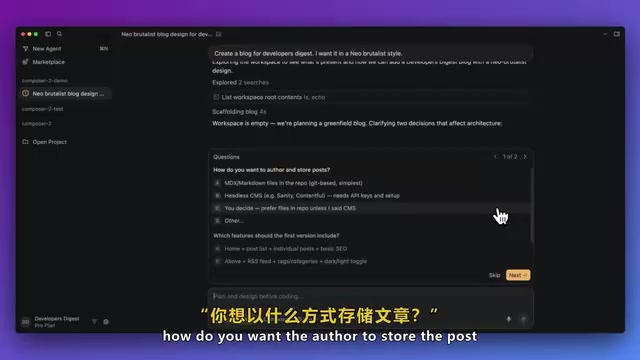
Major Cursor Update: Deep Dive into Composer 2 Model + Glass Interface
Deep dive into Cursor's latest Composer 2 model and Glass interface. Composer 2 scores 61.7% on Terminal Bench 2.0 with blazing inference speed; Glass brings intelligent planning, native Git integration, and multi-Agent management.
Read more →
 Tech Frontiers
·1 min
Gemini 3.5 Flash In-Depth Review: A Comprehensive Analysis of Agent Capabilities, Video Generation & Coding Performance
In-depth analysis of Google Gemini 3.5 Flash's three core strengths: Agent autonomous execution, sub-one-minute video generation, and 76.2% coding score. Compared with GPT and Doubao.
Read more →
 Tech Frontiers
·2 min
Advanced Remotion Tutorial: AI-Powered Data Animations & Video Asset Production
Advanced Remotion tutorial covering data chart animations, stock trend recreation, transparent background assets, and AI-powered ad generation—boosting video production efficiency 10x or more.
Read more →
 Expert Opinions
·1 min
Replit CEO Interview: AI Agent Capability Boundaries, Long-Horizon Reasoning Breakthroughs, and the AGI Dilemma
Replit CEO Amjad Masad on AI Agent long-horizon reasoning breakthroughs from 2 to 200 minutes, natural language programming, and why current AI utility may be AGI's biggest obstacle.
Read more →
 Tutorials
·2 min
ACPX in Practice: Scaling AI Agent Deployment on Kubernetes for Automated PR Processing
How to build an automated PR processing system using ACP protocol, ACPX workflow engine, and Kubernetes. From OpenCLO's 60K+ PR challenge to enterprise-grade multi-Agent orchestration.
Read more →
 Deep Dives
·2 min
How Replit Evaluates AI Coding Agents: A Deep Dive into ByteBench Benchmark and Continuous Optimization Framework
Deep dive into Replit's dual-pillar AI Agent evaluation framework, including open-source ByteBench benchmark, Telescope semantic clustering tool, and A/B test-driven continuous iteration methodology.
Read more →
 Product Reviews
·2 min
Hands-On Review of Miaoda AI Website Builder: Zero Code, Three Minutes to a Personal Website — Is It Really That Easy?
Hands-on review of Miaoda AI website builder: generate a personal website in 3 minutes through conversation with zero coding. Covers workflow, prompt tips, core strengths, and limitations.
Read more →
 Tutorials
·2 min
The Universal Formula for AI Website Creation: Five Modules for Generating Stunning Front-End Pages with AI
A detailed breakdown of the five-module prompt formula for AI website creation: role assignment, requirements, visual style, interactions, and tech stack for stunning front-end pages.
Read more →
 Tutorials
·2 min
AI Agent Auto-Generates Test Cases in Practice: A Hands-On Guide with MCP Server and Dify
Learn AI agent architecture (LLM + workflow + knowledge base), compare tools like Dify and LangChain, and use MCP Server to auto-generate test cases.
Read more →
 Tutorials
·2 min
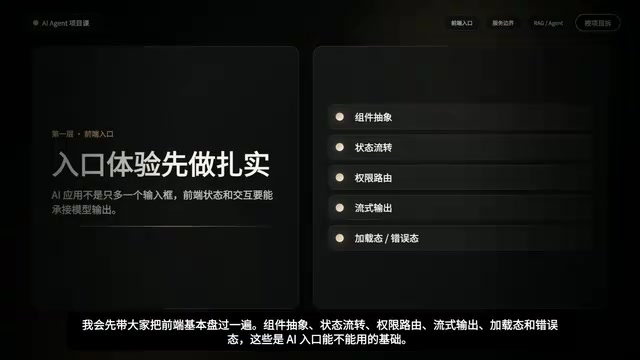
How Frontend Engineers Can Systematically Build AI Agent Architecture Skills
How frontend engineers can move beyond API calls to build production AI systems — covering streaming output, BFF layers, RAG pipelines, and Agent orchestration with LangChain.js/LangGraph.js.
Read more →
 Tutorials
·2 min
Build an AI Agent in 200 Lines of Python: A Deep Dive into Five Core Modules
Build an AI Agent in 200 lines of Python from scratch. A deep dive into the five core modules: Prompt, Memory, Tool Use, RAG, and Skill, with progressive development workflow.
Read more →
 Tutorials
·2 min
LLM Agent Development Learning Path: A Three-Step Practical Guide from Zero to Freelancing
A systematic three-step learning path for LLM Agent development: from Prompt Engineering and API calls, to RAG and vector databases, to ReAct and multi-agent systems.
Read more →
 Product Reviews
·1 min
Trae vs Qoder vs CodeBuddy: In-Depth Comparison of China's Top AI Coding Tools in 2025
In-depth comparison of ByteDance's Trae, Alibaba's Qoder, and Tencent's CodeBuddy—covering core capabilities, use cases, and target users with detailed analysis to help you pick the best AI coding assistant.
Read more →
 Tutorials
·2 min
Trae IDE + Image-Color AI Programming in Practice: Complete Workflow for Automated Image Finding and Clicking
Complete walkthrough of Trae IDE agent configuration and image-color automation plugin development, demonstrating AI-written image finding, ORB algorithm switching, and auto-clicking features.
Read more →
 Tutorials
·3 min
Full-Stack Development for Beginners in the AI Era: Don't Write Code — Learn to Manage It
AI coding tools make code generation easy, but a huge gap remains between code and product. This article breaks down frontend, backend, and DevOps stacks, exploring how beginners can manage code with AI.
Read more →
 Tutorials
·2 min
EasyClick Multi-IDE Collaborative Programming in Practice: Three Approaches to Double Your Development Efficiency
Three multi-IDE collaboration strategies for EasyClick development: UI/script separation, plugin modules, and modular splitting. Combine Trae, Lingma, Cursor to break single-IDE limitations.
Read more →