#Superpower framework
48 related articles
 Tech Frontiers
·1 min
Superpowers Open-Source Framework: A Methodology for Making AI Coding Assistants Think Before They Code
Superpowers is an open-source AI coding framework with 180K GitHub Stars that uses Spec First, TDD, and Subagent task decomposition to transform AI assistants from code generators into engineering partners.
Read more →

·3 min
Greek Fire: The Ultimate Military Secret Guarded by the Byzantine Empire for a Millennium
Greek Fire was the Byzantine Empire's most closely guarded state secret — an ancient flamethrower that burned on water. Learn how it helped repel Arabs and Vikings and ensured the empire's survival.
Read more →

·4 min
Disaster and Glory of the Apollo Program: The History We Must Revisit Before Returning to the Moon
From the fatal Apollo 1 fire to Apollo 8's daring lunar orbit to Apollo 11's successful landing—revisiting the disasters, fears, and compromises of the Apollo program and their lessons for today's return to the Moon.
Read more →

·4 min
The Truly Scarce Skills of the AI Era: Why Focus and Execution Are the New Moat
When AI tools let everyone code and design, where is your edge? A deep analysis of why focus and execution are the scarcest superpowers in the AI era.
Read more →

·3 min
Pi Agent Configuration Guide: Building Your Own AI Coding Assistant
A step-by-step Pi Agent configuration tutorial covering installation, LLM connection, extension ecosystem, MCP setup, and Token-saving tips. Learn to build a truly controllable AI coding assistant.
Read more →

·5 min
From Vibe Coding to AI Engineering: A Complete Guide to Enterprise-Grade Development
In the AI programming era, Vibe Coding alone can only build toys. This article deeply analyzes the complete engineering path from Vibe Coding to SDD spec-driven development, covering Claude Code and Codex tool selection, the SuperPower plugin, and domestic LLM comparisons.
Read more →

·4 min
Beyond Vibe Coding: A Complete Guide to Enterprise-Grade AI Engineering
Hit the Vibe Coding ceiling? This guide covers the three-stage AI coding progression path, Claude Code vs. Codex, SuperPower SDD, and how to go from vibe coding to enterprise-grade AI engineering.
Read more →
·4 min
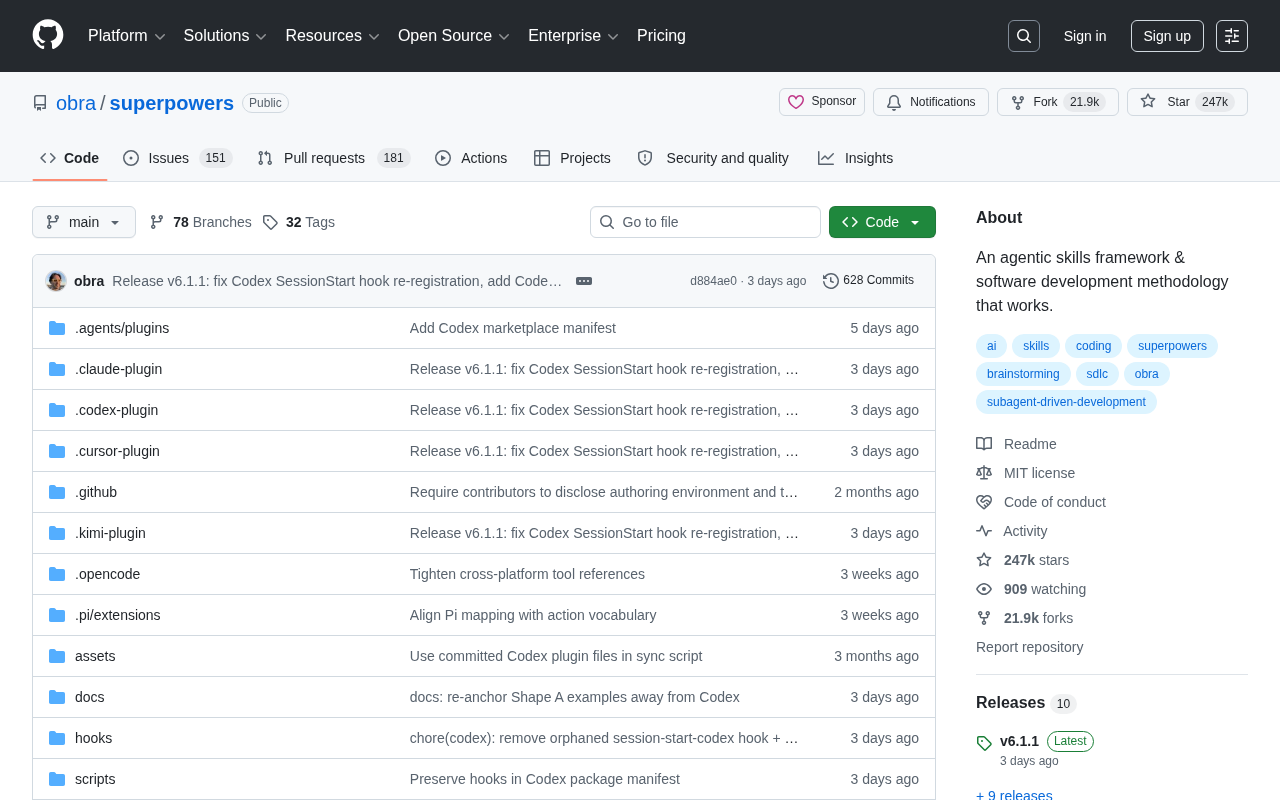
Superpowers: Enabling AI Agents to Truly Master Software Development Methodology
Superpowers is a trending GitHub project that builds an agentic skills framework with Shell scripts, injecting software engineering methodology into AI coding workflows. A deep dive into its architecture and value.
Read more →

·3 min
GitHub Daily · July 12: The Explosion of the Agent Skills Ecosystem and the Rust Rewrite Wave
July 12 GitHub trending: Agent Skills/MCP ecosystem explodes with superpowers hitting ~900 stars, pgrust rewrites Postgres in Rust passing 100% tests, plus solid engineering foundations.
Read more →

·3 min
GPT-5 Is Here — Is Learning Java Still Worth It? How Programmers Can Pivot in the AI Era
Is learning Java still worth it after GPT-5? Explore why programming fundamentals still matter and how to pivot toward AI application development in the AI era.
Read more →

·3 min
GitHub Daily · July 10: The Agent Skills Ecosystem Explodes — AI Coding Enters the 'Skills Library' Era
July 10 GitHub Daily: The Agent Skills ecosystem explodes as over half of trending projects revolve around AI coding Agent skill libraries, with MCP as the standard interface.
Read more →

·6 min
A Three-Month AI Agent Learning Roadmap: From Zero to Hands-On Agent Development
A systematic breakdown of the complete AI Agent learning roadmap, covering prompt engineering, the ReAct paradigm, memory mechanisms, and multi-agent collaboration, with hands-on project advice.
Read more →

·5 min
Advanced Vibe Coding: How SuperPowers and GStack Make AI Coding Truly Converge
In the age of AI-assisted programming, how do you make tools like Codex and Claude Code output more stably? This article deeply analyzes SuperPowers and GStack, covering project-level orchestration and module-level code layering to help developers master AI coding.
Read more →

·6 min
The Hidden Cost of AI-Assisted Programming: How Developers Can Cope with LLM Burnout
When GitHub Copilot, ChatGPT and other AI coding tools shift from help to burden, developers face a new kind of professional fatigue—LLM burnout. Learn its causes, symptoms, and coping strategies.
Read more →

·6 min
The Privacy Dilemma of Smart Glasses: Who's Being Watched?
The biggest obstacle to smart glasses adoption isn't technology—it's the privacy trust crisis. From Google Glass's failure to Meta's new generation, this article explores how wearable cameras break social trust.
Read more →

·6 min
Escaping AI Agent Skill Hell: A Complete 4-Step Guide to Writing High-Quality Skills
Matt Pocock's 4-step framework for AI Agent Skill design: Trigger, Structure, Steering, Pruning. Escape skill hell, tell good skills from bad, and master leading words to make Agents follow your intent.
Read more →

·6 min
Escaping AI Agent Skill Hell: A Complete 4-Step Guide to Writing High-Quality Skills
Matt Pocock's 4-step framework for AI Agent Skill design: Trigger, Structure, Steering, Pruning. Escape skill hell and learn to write high-quality skills.
Read more →

·7 min
Engineering Vibe Coding in Practice: Taming AI Programming with Superpowers and gstack
A deep dive into engineering Vibe Coding: using Superpowers for project-level decomposition and gstack for module layering and constraints to tame AI coding assistants like Codex and Claude Code.
Read more →

·6 min
White House Pressures World Cup Red Card: The Battle Over Sports Independence vs. Political Interference
The White House tried to overturn a World Cup red card, sparking global debate. This article analyzes sports governance independence, VAR technology limits, and the risks of political interference in sports officiating.
Read more →

·3 min
Benchmarking Popular Claude Skill Libraries: A 5-Step Core Pattern for AI Agent Development
A deep-dive evaluation of Addy Osmani, Matt Pocock, and Gary Tan's skill libraries, distilling a 5-step Research→Prototype→Plan→Build→Test agent dev loop and why the best skill system is always your own.
Read more →