#embedding vectorization
183 related articles

·7 min
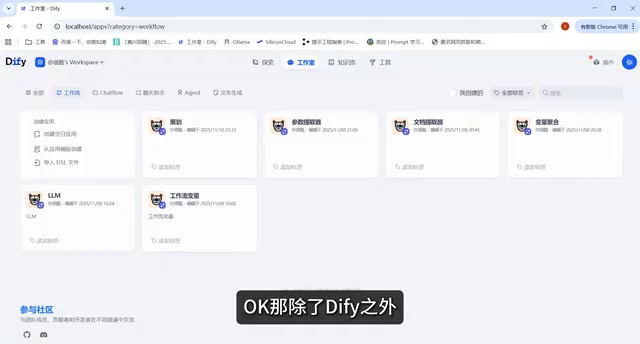
Dify 1.8.0 in Practice: A Complete Guide to Building Enterprise-Grade AI Workflows with Zero Code
An in-depth walkthrough of deploying Dify 1.8.0 and building applications: three-step Docker deployment, five app types compared, and Workflow vs Chatflow use cases—build enterprise AI apps with zero code.
Read more →
·6 min
Complete Guide to Deploying Dify Locally: Docker + Ollama + RAG Setup Tutorial
A detailed guide to deploying the Dify agent platform locally: from Docker setup and integrating Ollama + DeepSeek local LLMs to workflow orchestration and RAG knowledge base construction.
Read more →

·7 min
Getting Started with Dify: A Complete Guide from Local Deployment to Building Enterprise-Grade AI Applications
A detailed guide to Dify, the open-source LLM app development platform, covering its core features and full local deployment via VMware + Ubuntu + aaPanel + Docker. Supports 100+ models like DeepSeek and ChatGPT to build enterprise AI apps fast.
Read more →

·6 min
Getting Started with Dify: A Complete Guide to Deployment, Configuration, and Workflow Practice
A systematic guide to Dify's three deployment methods (Docker/source/online), five application types, and hands-on workflow nodes—covering LLM integration, MySQL config, and app publishing.
Read more →

·7 min
Gemini Meets Google Business Profile: How AI Becomes a Dedicated Business Partner for Small Businesses
Google lets businesses connect their Google Business Profile to Gemini, so the AI can read operating info, reviews, and business data to offer targeted marketing advice—lowering AI barriers for SMBs.
Read more →

·7 min
Zero-Basis Learning Path for AI Agents: A Three-Stage Journey from Beginner to Deployment
A systematic zero-basis learning path for AI Agent development, covering Python and LLM fundamentals, five core capabilities like task planning and RAG, and LangChain hands-on practice.
Read more →

·7 min
A Java Developer's Guide to AI: Framework Selection and Practical Tutorial for LangChain4J
As LLM costs keep falling, how can Java developers seize the AI opportunity? This article explores LangChain4J's core capabilities, supported models and vector databases, and compares LangChain4J vs. Spring AI to help you build local knowledge bases and intelligent customer service systems.
Read more →

·6 min
Coze from Scratch: A Complete Guide to Building Multi-Agent Collaboration
A detailed guide to Coze's core features: cross-platform interoperability, the Skills system, multi-agent collaboration, and workflow building. Compare Coze and Dify to build practical AI apps with zero coding.
Read more →
·7 min
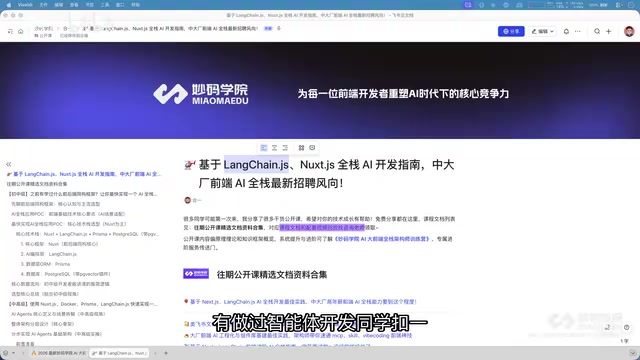
LangChain.js + Nuxt.js: An AI Full-Stack Advancement Path for Frontend Engineers
Frontend hiring now treats AI capabilities as a core assessment, covering RAG knowledge bases, AI Agent development, and LangChain.js engineering. Learn how LangChain.js + Nuxt.js helps frontend developers build memory- and retrieval-capable AI full-stack apps.
Read more →

·7 min
The Birth of Claude Code: Design Philosophy from Internal Tool to AI Programming Assistant
An in-depth look at Claude Code's development and design philosophy: why the CLI form, how the "minimal scaffolding" architecture works, and how it balances safety with autonomy in AI programming.
Read more →

·4 min
Ternlight: A 7MB Browser-Side Embedding Model for Server-Free Semantic Search
Ternlight is a 7MB WebAssembly-based browser-side text embedding model requiring no server or GPU. Explore its tech, use cases, and tradeoffs for private, offline semantic search.
Read more →

·7 min
Kontext: One-Click AI Conversation Context Migration, Breaking Down Multi-Model Switching Barriers
Kontext is a context migration tool for multi-AI users, enabling one-click transfer of full conversation history between ChatGPT, Claude, and Gemini to solve the context silo problem.
Read more →

·5 min
NVIDIA AI-Q Blueprint × OCI: A Practical Guide to Production Deployment of Enterprise AI Agents
Deep dive into NVIDIA AI-Q Blueprint production deployment on Oracle Cloud Infrastructure, covering NIM microservices, RAG architecture, multi-agent orchestration, and OCI GPU selection for enterprise AI agents.
Read more →

·7 min
Spring AI 2.0 in Practice: A Beginner's Guide for Java Developers Building AI Agents
A complete Spring AI 2.0 guide for Java developers covering unified API abstraction, RAG, tool calling, MCP protocol, and enterprise projects to build AI Agents.
Read more →

·6 min
5 Critical Engineering Pitfalls in Enterprise RAG Knowledge Base Deployment: The Real Barriers from Demo to Production
Why do enterprise RAG knowledge bases dazzle in demos but fail in production? This article dissects five critical engineering pitfalls with real-world case studies from million-doc platforms and ops agents.
Read more →

·6 min
14x Speedup: How Manticore Rebuilt the ONNX Embedding Inference Path
Manticore Search restructured its ONNX inference path to achieve 14x faster text embeddings. Deep dive into batching, session reuse, zero-copy memory, and thread tuning for vector search systems.
Read more →

·4 min
Coze for Beginners: A Complete Guide to ByteDance's AI Application Development Platform
A complete guide to ByteDance's Coze platform: agents, AI apps, workflows, nodes, and plugins explained. Build AI applications with no coding required.
Read more →

·3 min
Building a RAG Q&A Workflow with Dify: A 4-Step Guide to Enterprise Knowledge Base Chatbots
Learn RAG fundamentals and build an enterprise knowledge base chatbot with Dify in 4 steps: data prep, model config, knowledge base import, and workflow orchestration.
Read more →

·3 min
Codex CLI Practical Guide: From Setup to Enterprise-Level AI Development
Master OpenAI Codex CLI from setup to enterprise use: slash commands, AGENTS.md, MCP protocol, multi-agent coordination, plugin development, and RAG project implementation.
Read more →

·3 min
Why Claude Code Ditched RAG for Grep: The Engineering Logic Behind the Decision
Why did Claude Code abandon RAG for Grep? Breaking down the three root causes — undiagnosability, the multiplication effect, and index staleness — behind the shift to Agentic Search.
Read more →