#multi-Agent parallel
656 related articles
 Product Reviews
·3 min
Claude Haiku 4.5 In-Depth Review: Twice the Speed, But Can It Replace Sonnet?
Independent developer benchmarks Claude Haiku 4.5 vs Sonnet in agentic coding using a multi-agent monitoring system, revealing speed gains, precision gaps, and the optimal model hierarchy strategy.
Read more →
 Product Reviews
·2 min
Claude Haiku 4.5 In-Depth Review: One-Third the Cost, Coding Performance Rivaling Sonnet 4
Anthropic releases Claude Haiku 4.5: coding rivaling Sonnet 4 at 1/3 the cost and 2x speed. A dev built browser-based macOS for just 28 cents, redefining small AI model capabilities.
Read more →
 Tech Frontiers
·2 min
Claude Haiku 4.5 Deep Dive: The Cost-Performance Champion with 2x Speed and 66% Lower Cost
Deep dive into Anthropic's Claude Haiku 4.5: a lightweight AI model with nearly 2x speed, 66% lower cost, and multi-agent support—ideal for developers seeking performance at scale.
Read more →
 Tutorials
·3 min
51.8K Stars! Claude Code Best Practices: A Complete Guide from Getting Started to Agent Engineering
Deep dive into the 51.8K Star Claude Code best practices project on GitHub, covering Prompt Engineering, efficient Web Coding, multi-Agent collaboration, and more.
Read more →
 Tutorials
·3 min
Building an AI Workstation: A Layered Tool Strategy and Physical Isolation Guide
A practical guide to building an AI workstation: physical isolation with vertical screens, pyramid tool layering (Doubao/Trae/Claude/GPT-4), and real Token cost breakdowns to maximize AI workflow efficiency on a budget.
Read more →
 Expert Opinions
·4 min
Is CI/CD Dead? The Continuous Computation Architecture Revolution in the AI Agent Era
Traditional CI/CD pipelines are being shattered by AI Agents. This article analyzes the shift from PR-driven to intent-driven architecture, exploring Pre-Merge queues, stateful environments, and multiverse development as new continuous computation paradigms.
Read more →
 Product Reviews
·3 min
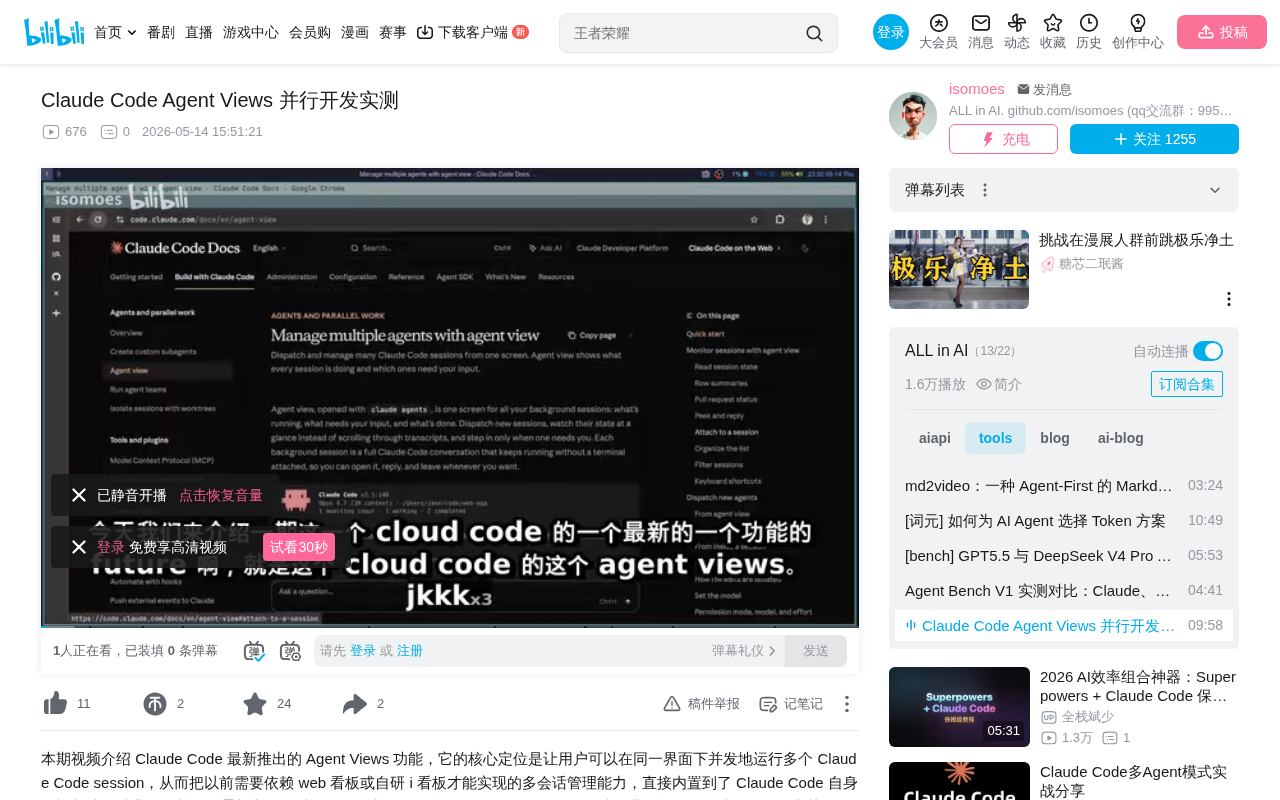
Claude Code Agent Views Hands-On: Parallel Development Experience & Pitfall Guide
Hands-on review of Claude Code Agent Views parallel development: cross-project parallel, Git Worktree multi-branch workflows, Space compact mode, plus key caveats on rate limits and Worktree merging.
Read more →
 Tutorials
·4 min
Claude Code Installation Guide: From Zero Setup to Multi-Agent Collaboration in Practice
Complete Claude Code installation guide covering environment setup, one-command install, troubleshooting, cost-saving alternatives, and multi-Agent collaboration tips for beginners.
Read more →
 Deep Dives
·3 min
Microsoft Magentic-UI Explained: A Human-AI Collaborative Agent Operating System
Deep dive into Microsoft's open-source Magentic-UI: a human-AI collaborative Agent platform built on AutoGen. Explore its five core capabilities, system architecture, and Human-in-the-Loop design.
Read more →
 Product Reviews
·3 min
Cursor In-Depth Review: Four Modes + Parallel Agents — Why It Remains the Best AI Coding Tool
In-depth comparison of Cursor vs Claude Code, Windsurf, Trae, and other AI coding tools across Agent modes, terminal tools, browser integration, parallel processing, and context management.
Read more →
 Deep Dives
·4 min
The Four Stages of AI Agent Evolution: A Complete Guide from Copilot to Multi-Agent Collaboration
Deep dive into the four stages of AI Agent evolution: Chat, Copilot, Agent, and Agentic AI. Covers ReAct framework, Spring AI stack, and multi-Agent architecture design for 2025.
Read more →
 Deep Dives
·3 min
Hermes Agent Deep Dive: Five-Layer Memory Architecture and Self-Evolution Mechanism Fully Explained
A deep dive into Huawei's open-source Hermes Agent framework: five-layer memory architecture, self-evolution loop, multi-agent collaboration, and comparison with Open Manus.
Read more →
 Expert Opinions
·4 min
Interview with a Core Developer of Microsoft's Agent Framework: A Complete Analysis of Architecture Design and Evolution
In-depth interview with Microsoft Agent Framework core developer Roger Barreto on the evolution from Semantic Kernel, middleware architecture design, enterprise stability strategies, and AI development best practices.
Read more →
 Research
·3 min
MEMOIR: Solving AI Agent Memory Management with Git Version Control
MEMOIR is an open-source tool bringing Git version control to AI Agent memory management, with branching, rollback, semantic paths, and visualization to solve context pollution and memory drift.
Read more →
 Tutorials
·4 min
A Practical Guide for Java Developers Transitioning to AI Agent Development: Technology Selection, Architecture Design & Resume Positioning
A systematic guide for Java developers entering AI Agent development, covering core concepts, Workflow vs. Agent architecture comparison, Spring AI Alibaba selection, and resume positioning strategies.
Read more →
 Deep Dives
·4 min
From AIGC to AI Agent: Core Strategies and Practical Guide for Multi-Agent Development in 2025
Deep analysis of AIGC vs AI Agent differences, covering multi-agent system architecture, task orchestration, hallucination control, with developer skill roadmap and career outlook.
Read more →
 Tutorials
·4 min
Agentic RAG in Practice: Architecture Deep Dive and LangChain Implementation Guide
Compare traditional RAG vs Agentic RAG architectures, explore planning, tool use, and multi-step iteration capabilities, with full LangChain/LangGraph ReAct Agent code and ChatBoss project examples.
Read more →
 Deep Dives
·2 min
Cursor SDK /orchestrate Explained: Recursive Multi-Agent Collaboration for Complex Programming Tasks
Cursor SDK launches /orchestrate skill, using recursive multi-agent spawning for complex tasks with 20% Token savings and 80% faster cold starts.
Read more →
 Tech Frontiers
·3 min
LangGraph Multi-Agent Company Research Tool: A Practical Guide to Open-Source AI Due Diligence
Deep dive into the open-source company-research-agent: LangGraph multi-agent architecture + Tavily search + dual-LLM collaboration for automated company due diligence and competitive intelligence.
Read more →
 Deep Dives
·3 min
Claude's Advisor Strategy: Small Models Execute, Large Models Supervise — A New Cost-Saving Paradigm for AI Agents
Anthropic's Advisor Strategy lets Sonnet execute tasks while Opus serves as advisor, cutting costs 12% while boosting SWE-Bench by 2.7 points. A new multi-model AI Agent paradigm explained.
Read more →