#multi-model AI interface
483 related articles
Microsoft's Two-Track AI Coding Strate…
·3 min
Microsoft's Two-Track AI Coding Strategy: A Deep Dive into Claude Code and GitHub Copilot CLI
Microsoft plans to launch Claude Code and GitHub Copilot CLI, making the terminal the new frontier for AI coding. A deep dive into Microsoft's multi-model strategy and its impact on developer workflows.
Read more →

·3 min
Opal: A Designer Built an AI Pet Assistant on Raspberry Pi Using OpenClaw
Microsoft designer Tua Nguyen built Opal, an AI rabbit assistant on Raspberry Pi using OpenClaw — capable of browsing the web, finding recipes, and operating GitHub.
Read more →
transcribe.cpp: A Unified Speech Recog…
·2 min
transcribe.cpp: A Unified Speech Recognition Engine Built on ggml, Supporting 16+ Model Families
transcribe.cpp is an open-source ggml-based speech recognition engine supporting 16+ model families in a single C++ codebase — lightweight, cross-platform, and quantization-ready for local STT.
Read more →

·2 min
Vibe Coding vs AI Engineering: A Practical Enterprise-Level Comparison Guide
A deep dive comparing Vibe Coding vs AI Engineering, with hands-on analysis of Claude Code and Codex, two real projects, and the role of Skills in enterprise AI development.
Read more →

·3 min
Free Claude Opus 4.6 Access: Complete Guide to Connecting Antigravity via CLIProxyAPI
Use CLIProxyAPI to connect Antigravity's free models to Claude Code, Cline, and more. Access Claude Opus 4.6 Thinking and Gemini 3 Pro at zero cost. Full setup guide included.
Read more →

·2 min
Claude Code with Open-Source Models: Why Cache Misses Happen and How to Fix Them
Why Claude Code cache misses occur with DeepSeek and MiniMax, how Prompt Cache and KV Cache work, and practical solutions including API proxy layers and stable prefix strategies to cut AI coding costs.
Read more →

·3 min
The AI Video Agent Era: A Full Walkthrough of Creating a Professional Brand Film in Two Hours
LiblibTV's AI Agent feature tested end-to-end: from a one-sentence brief through storyboarding, Seed Audio music, and CapCut editing to a polished brand film in under two hours.
Read more →

·3 min
Building a Video Generation Agent: Lessons Learned from Brief to Storyboard
A developer's hands-on account of building a brief-to-storyboard video Agent: JSON errors, missing fields, pacing issues — and how JSON Schema, retry loops, and MCP tools solved them.
Read more →

·2 min
Complete Tutorial: Building Agents and Personal Knowledge Bases with DeepSeek
A complete guide to building AI agents with DeepSeek R1: private knowledge bases using RAG, basic/advanced agent implementation, and Coze/Dify workflow tutorials.
Read more →

·2 min
Perplexity Pro Quietly Swapping Models? Forced Sonnet Switching in MCP Scenarios Sparks Trust Crisis
Perplexity Pro users report that custom MCP connectors silently switch models to Claude Sonnet, ignoring frontend selections like Grok or GPT. Support denies it.
Read more →

·3 min
Perplexity Max Deep Dive: Is the $200/Month Plan Worth It? The Truth About Credit Consumption
A Reddit user's real experience with Perplexity Max ($200/month): 15,000 credits burned on one task, failed Grok integration, and complex MCP setup. Is it worth it?
Read more →

·3 min
OpenClaw Multi-Agent AI Programming Workflow in Practice: From Coder to Manager
Deep dive into OpenClaw multi-agent AI programming workflows: context layering, CMUX parallel terminal management, work trees, and manager-perspective debiasing for scalable AI dev automation.
Read more →

·3 min
Pi Agent Review: A Minimalist Coding Agent That's Lightweight, Efficient, and Highly Customizable
Pi Agent hands-on review: ~1,200 token overhead, no built-in system prompts, supports Codex/Grok and more. Compared to Claude Code and OpenCode, Pi Agent wins with minimalist design and full customizability.
Read more →

·3 min
OpenCode In-Depth Review: Can This Open-Source Coding Agent Replace Claude Code?
OpenCode is an open-source terminal coding agent with 180K+ GitHub stars, supporting hundreds of models and a dual-layer agent architecture — completely free. See how it compares to Claude Code.
Read more →

·2 min
Why System Architects Are Becoming the Most In-Demand Tech Talent in the AI Era
A veteran architect with 10+ years of experience reveals: in the AI coding era, the real scarcity isn't people who write code — it's people who design great systems.
Read more →

·3 min
Coze Deep Dive: Core Capabilities and Tips for a Multi-Agent Collaboration Platform
A deep dive into Coze 3.0's multi-agent collaboration, covering project workspace architecture, credit economics, local tool integration, and a Dify comparison.
Read more →

·2 min
GPT-5.6 Three-Model Showdown: How Luna, Terra, and SOL Divide the Work to Save You Money
Is your $20/month ChatGPT Plus worth it? We test GPT-5.6's three models—Luna, Terra, and SOL—to show how to assign tasks smartly and get the most value.
Read more →

·3 min
AI Coding Agents Explosion: CodeWell Goes Open Source, Kimi K3 Launches, Claude Gets Browser Access
CodeWell open-sources a multi-model terminal coding agent, Kimi K3 launches with ultra-long context, MiniMax Code 2.0 rebuilds its Agent architecture, and Claude gets browser access. AI is accelerating from content generation to task execution.
Read more →
·3 min
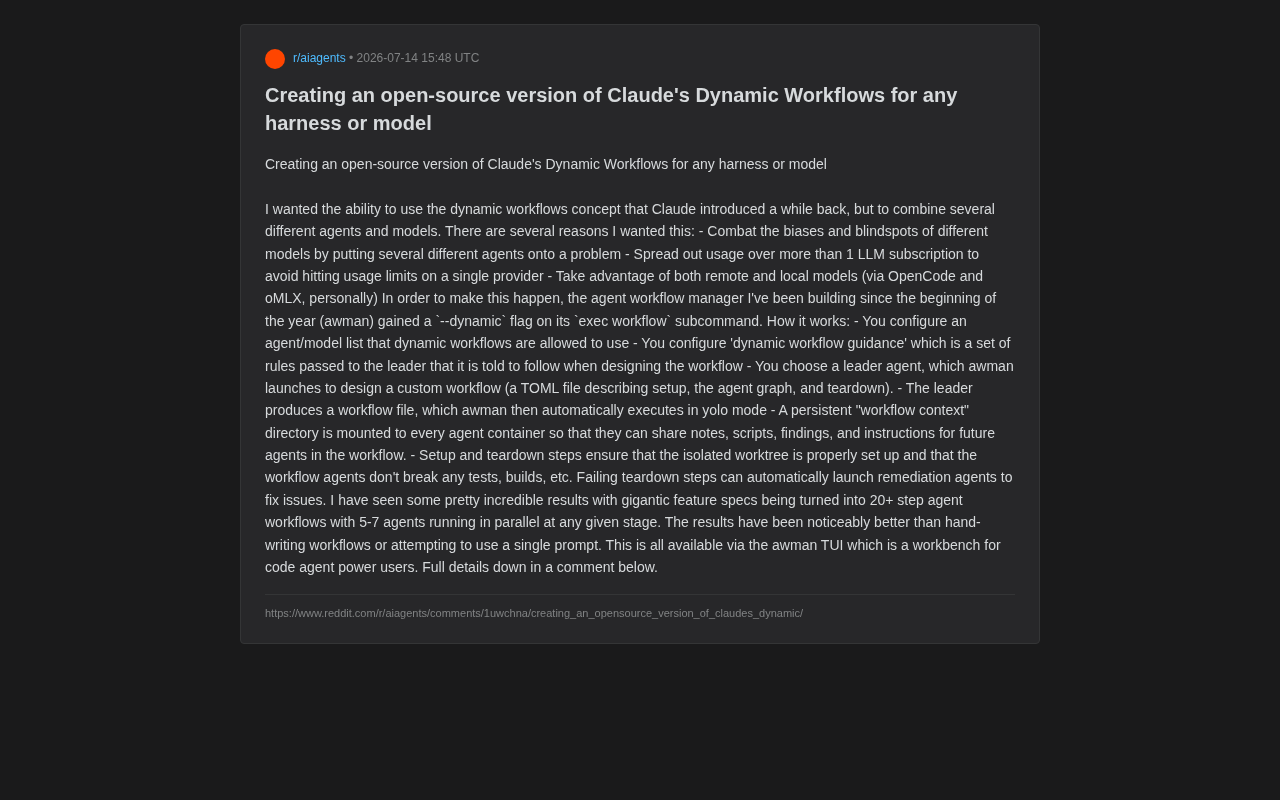
Open-Source Dynamic Workflows: How awman Enables Multi-Model Collaborative AI Programming
awman's --dynamic flag enables cross-framework dynamic workflows with multi-model collaboration. Explore its leader agent architecture, shared context design, and auto fault-tolerance mechanisms.
Read more →

·3 min
Agent Performance Evaluation: A Three-Layer Framework and Engineering Implementation Guide
A deep dive into the three-layer AI Agent evaluation framework — outcome, process, and system layers — covering trajectory evaluation, tool call accuracy, automated testing, and key engineering challenges.
Read more →