#multi-model scheduling
84 related articles

·3 min
SlickToken: A Deep Dive into GPU Fleet and Agentic Workflow Planning
SlickToken is a GPU fleet and agentic workflow planning tool for AI teams, supporting offline simulation, load testing, and capacity planning—no internet required to protect enterprise data.
Read more →

·5 min
Multi-Model Tiered Deployment: Is an AI Gateway Worth Adopting?
More teams are adopting multi-model tiered scheduling. AI gateways solve cross-vendor API management, automatic fallback, and cost tracking — but add a new abstraction layer. Learn when a gateway is worth it.
Read more →

·7 min
GPT-5.6 Becomes Microsoft Copilot 365's Preferred Model: An In-Depth Look at the OpenAI-Microsoft Partnership
OpenAI confirms GPT-5.6 as the preferred model for Microsoft Copilot 365, responding to "breakup rumors." A deep dive into the strategy, multi-model trends, and AI productivity commercialization.
Read more →

·6 min
AI's Second Half: The Decisive Battle Shifts from Models to Infrastructure
Model capabilities are converging, making inference cost and scalability the new focus of AI competition. A deep analysis of AI infrastructure's core layers.
Read more →

·6 min
Dify Local Deployment in Practice: A Complete Guide to Building an AI Application Platform with Docker
A complete guide to Dify local deployment: from Docker environment setup, source code pulling, and container startup to first access. Build a private AI app development platform across Linux, Windows, and Mac for fast enterprise AI deployment.
Read more →

·7 min
Harness Engineering: The Six-Layer Engineering Framework for Enterprise AI Agent Deployment
From Prompt Engineering to Harness Engineering, a deep dive into the core challenge of truly deploying AI Agents in enterprises. This article breaks down the six-layer architecture and shares real-world Hermes Agent practice.
Read more →

·7 min
Electron + LangGraph in Practice: Building an AI Agent Visual Orchestration App from Scratch
A hands-on guide to building an enterprise-grade AI Agent workflow orchestration app with Electron Forge and LangGraph, covering local LLM deployment (Qwen3-0.6B), node-based visual canvas design, and full Function Calling integration.
Read more →
·5 min
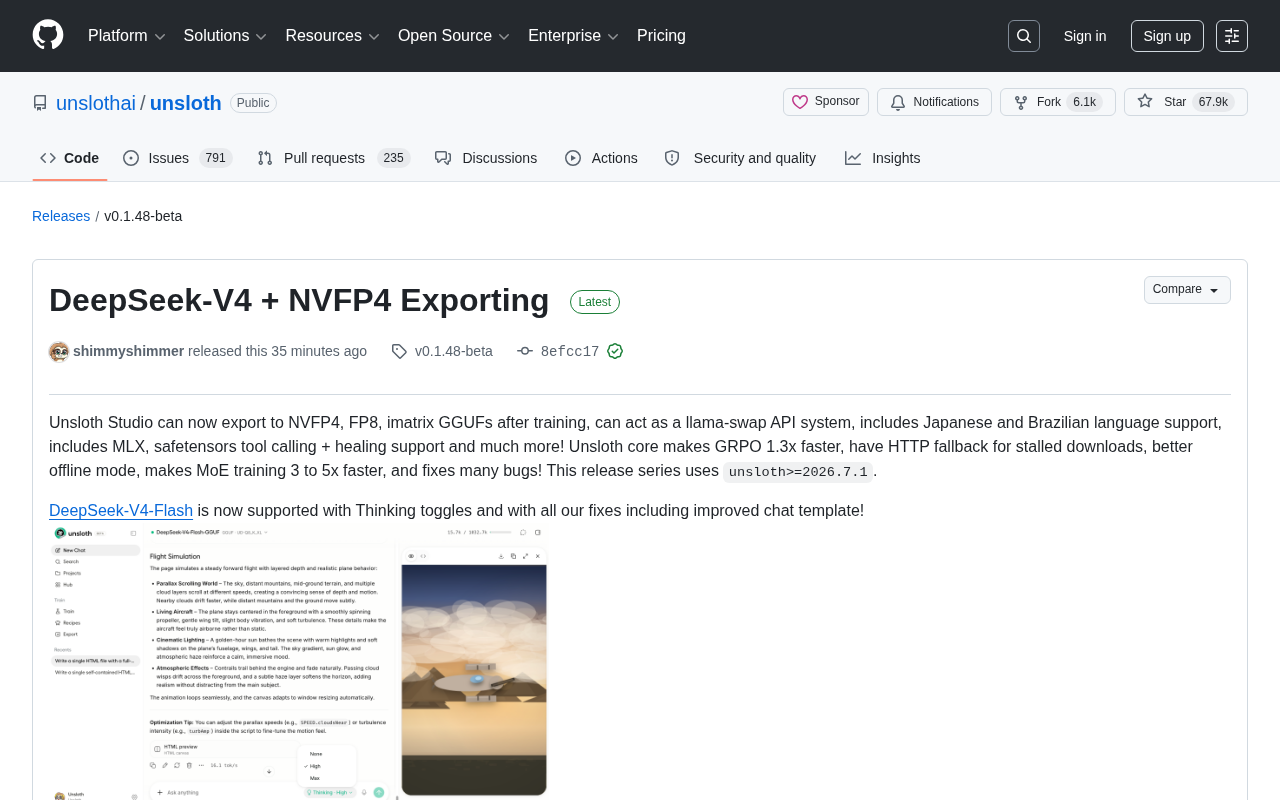
Major Unsloth Update: NVFP4 Quantization Export and DeepSeek-V4 Training Support
Unsloth v0.1.48-beta released, adding NVFP4/FP8 quantization export, OpenAI-compatible API hot-swapping, 3-5x faster MoE training, and 1.3x faster GRPO, covering the full LLM fine-tuning, quantization, and local deployment pipeline.
Read more →

·3 min
OpenAI's Official Plugin codex-plugin-cc: Calling Codex Inside Claude Code for Dual-AI Collaboration
OpenAI's open-source codex-plugin-cc plugin lets developers call Codex inside Claude Code for code review and task delegation. 22K+ GitHub stars signal AI coding's multi-model era.
Read more →

·3 min
Zhipu GLM-5.2 Officially Launches | Full Breakdown of Anthropic's U.S. Export Control
Zhipu GLM-5.2 launches with tiered thinking and long-context support, while Anthropic faces rare U.S. export controls over AI security vulnerabilities. Full breakdown.
Read more →

·7 min
Otari: A Comprehensive Look at the Open-Source LLM Control Plane Tool
An in-depth analysis of the open-source LLM control plane tool Otari—covering unified multi-model access, cost observability, and security compliance governance to help teams build manageable, production-grade AI infrastructure.
Read more →

·3 min
GLM-5.2 vs GPT-5.5: Solving the Mind Map Vertical Centering Problem — A Real-World Comparison
A developer found GPT-5.5 couldn't fix a mind map vertical centering bug, but GLM-5.2 solved it quickly. This article analyzes the capability differences and the value of multi-model collaboration in AI-assisted programming.
Read more →

·4 min
Complete Guide to Connecting External Models in Codex: Two Methods to Unlock Full Capabilities
Two methods for connecting external models to Codex: manually configure keys via relay services, or use the CC Tool to auto-bridge GPT, DeepSeek, and more. Covers auth/config files, CC Tool usage, and multi-model switching.
Read more →

·4 min
Building an AI Agent Framework from Scratch: Deep Dive into Tool Calling, Memory, and Dual-Model Scheduling
Build an AI Agent from scratch — no frameworks. Deep dive into Function Call schema design, MCP remote mirroring, dual-model routing, and short-term memory management.
Read more →

·6 min
Codex Beginner's Guide: Four Product Forms Explained, Plus Comparison with Claude Code and Cursor
In-depth analysis of OpenAI Codex's four usage forms, comparing Codex, Claude Code, and Cursor across price, stability, and frontend/backend fit to help developers choose the right AI programming tool.
Read more →
Devin Adds Kimi K2.7 and GLM 5.2 — Bot…
·2 min
Devin Adds Kimi K2.7 and GLM 5.2 — Both Models Free With No Quota Until July 5
Devin now supports Kimi K2.7 and GLM 5.2 on Desktop and CLI. Pro, Max, and Teams users can use both models quota-free until July 5. Strong FrontierCode Extended benchmark results make this a perfect evaluation window.
Read more →

·3 min
GitHub Daily · July 4th: The Agent Skills Ecosystem Explodes
GitHub Trending July 4: The AI Agent ecosystem explodes across specs, frameworks, and apps — from agentskills to Vibe-Trading, a full Agent tech stack emerges.
Read more →

·4 min
AI Workbench: One-Click Content Creation from Topic Research to Final Output
AI Workbenches automate the full content creation pipeline — from topic research to visual output. Multi-model routing, transparent execution, and reusable workflow templates redefine how creators work.
Read more →

·6 min
Dify Self-Hosted Deployment in Practice: Building an Enterprise-Grade AI Application Platform from Scratch
A complete guide to self-hosting Dify, the open-source AI platform: environment setup, Docker Compose deployment, LLM integration, and app building. Runs on just 2 cores and 4GB RAM.
Read more →
Has AI Coding Assistant Fable Been Ner…
·4 min
Has AI Coding Assistant Fable Been Nerfed? Developer's Routing Anomaly Report Sparks Debate
A developer questioned whether AI coding assistant Fable was nerfed, finding 4–10x more tokens routed to Opus with Fable doing ~20% of the work. A deep dive into multi-model routing, transparency, and AI trust.
Read more →