#emergence
1317 related articles

·2 min
GLM 5.3 Released: Frontier Coding Capabilities and Emergent Cybersecurity Abilities Explained
Zhipu AI releases GLM 5.3 with frontier coding capabilities and emergent cybersecurity abilities. This analysis covers technical breakthroughs in code generation, security auditing, and implications for developers.
Read more →

·3 min
DiffusionGemma Explained: Google Reimagines Text Generation with Diffusion Models
Deep dive into Google's DiffusionGemma technical report: how diffusion language models overcome autoregressive limitations with parallel decoding, global planning, and controllable text generation.
Read more →

·2 min
DCTS: A Deep Dive into the Open-Source Decentralized Self-Hosted Chat Platform
Deep dive into DCTS, an open-source decentralized self-hosted chat platform combining Discord, TeamSpeak & Messenger features. Explore its architecture, data sovereignty benefits & deployment considerations.
Read more →

·2 min
DeepSeek Harness rc.8 Released: Major Upgrades to Multimodal Image Understanding and Sub-Agent System
DeepSeek Harness rc.8 brings multimodal image processing, on-demand sub-agents, Windows terminal persistence, and SQLite optimization. The open-source Agent framework with 170K+ GitHub stars iterates at remarkable speed.
Read more →

·3 min
DeepSeek Harness Deep Dive: The 'Everything Is a Plugin' Paradigm for AI Programming
DeepSeek's open-source Harness framework, built on Cordis Kernel, uses an 'everything is a plugin' design for ultimate customization. Supports multi-model integration, built-in traceability, and Creator mode self-extension.
Read more →

·2 min
Prized: Enabling Non-Engineers to Build Secure, Compliant Internal Tools
Prized is a security-first AI no-code platform that lets ops, support, and finance teams build internal tools without coding—featuring data scoping, audit trails, and enterprise SSO integration.
Read more →

·2 min
Berd: A Deep Dive into the Open-Source Mac Desktop AI Agent Workspace
Deep dive into Berd—an open-source Mac desktop AI Agent app with project management, skill configuration, multi-model support, and local context access for engineers and builders.
Read more →

·3 min
bitdrift.ai: Agent-Driven Mobile Observability Platform with 10x MTTR Improvement
bitdrift.ai is the world's first agentic mobile observability platform. AI Agents query full-fidelity data in real time, breaking release dependencies. Early users report 10x MTTR improvement.
Read more →

·3 min
NVIDIA Reveals SpaceX Holdings as Sixth-Largest Shareholder, Codex Unlocks Million-Token Context Window
NVIDIA reveals ~122.8M SpaceX shares as 6th-largest shareholder, Stripe acquires OpenRouter for $7B+, OpenAI Codex unlocks 1M context window, Meituan's Agent platform covers 90K employees.
Read more →

·2 min
Plane: Can This 56K Star Open-Source Project Management Tool Replace Jira?
Plane is an open-source project management platform with 56K+ GitHub Stars, supporting self-hosted deployment, task management, Sprints, and docs collaboration—a viable open-source alternative to Jira, Linear, and Monday.
Read more →

·2 min
Agent Substrate: Building an AI Agent Runtime Kernel in Go
Deep dive into Agent Substrate, an AI Agent runtime kernel built in Go. Explore its technical rationale for choosing Go over Python, task lifecycle management, state persistence, and its unique positioning as the substrate layer in the Agent tech stack.
Read more →

·3 min
Tencent Open-Sources AI-Infra-Guard: A Deep Dive into the Full-Stack AI Red Teaming Platform
Deep dive into Tencent's open-source AI-Infra-Guard full-stack AI red teaming platform, covering Agent scanning, MCP protocol scanning, LLM jailbreak evaluation, and more.
Read more →
·2 min
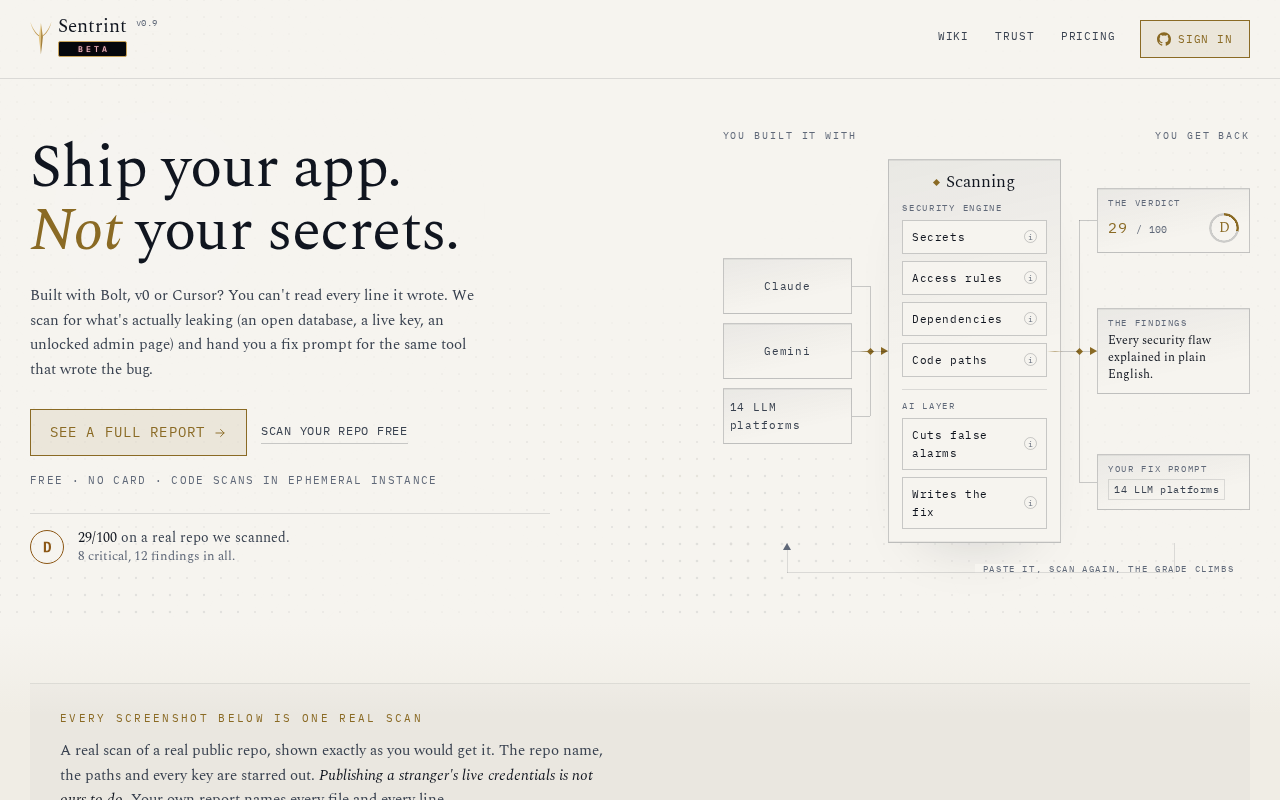
Sentrint: A Security Scanner Built Specifically for AI-Generated Code
Sentrint is a security scanner designed for LLM-generated code, detecting secret leaks, hallucinated dependencies, and injection vulnerabilities in AI code.
Read more →

·4 min
Implementing GRPO from Scratch: A Detailed Guide to Hand-Coding Reinforcement Learning in PyTorch
A detailed guide on implementing GRPO from scratch in pure PyTorch, covering group sampling, advantage normalization, probability ratio clipping, KL constraints, and more—runnable on consumer GPUs.
Read more →

·3 min
LangGraph Beginner's Guide: A Complete Tutorial for Building Enterprise-Grade AI Agents
LangGraph beginner tutorial covering environment setup, state management, and Graph API programming model to help developers build enterprise-grade AI Agent applications from scratch.
Read more →

·3 min
CHAP Protocol Explained: The Core Solution for Standardizing Human-AI Agent Collaboration
Deep dive into CHAP (Collaborative Human Agent Protocol): its design philosophy, core architecture, and application scenarios. Analysis of its relationship with MCP and A2A protocols.
Read more →

·3 min
DaxAI Robot Horse Debuts at WRC'26: An All-Terrain Quadruped with 300kg Payload and 40km/h Top Speed
DaxAI debuts an all-terrain robot horse at WRC'26 with 300kg payload, 40km/h top speed, and 100km range. Deep dive into its specs, applications, and commercialization prospects.
Read more →

·3 min
Agentic AI Meets RAG, LLM, and RL: A Complete Guide to the AI Agent Technology Stack
Deep dive into how Agentic AI integrates with RAG, LLM, and RL. Explore the agent tech stack's architecture, deployment challenges, and future trends for building production-grade AI applications.
Read more →

·2 min
Blume Documentation Framework: A New Markdown-First, AI-Ready Option
Blume is an AI-ready Markdown documentation framework built on Astro and Vite, offering full-text search, theming, SEO optimization, and one-command deploys.
Read more →

·3 min
Skriptr: A Deep Dive into the AI Learning Workspace That Won't Do Your Homework
Skriptr is an AI workspace for students featuring traceable citations, Socratic questioning, and preserved thought ownership. A deep dive into its features, philosophy, and differentiation from Notion AI and Perplexity.
Read more →