#observability
567 related articles

·6 min
Home Self-Hosting Server Setup Guide: Building a Private Cloud Ecosystem from Scratch
One 32GB server, 8 hours to build a complete home self-hosting ecosystem. This article details the selection logic behind core services like Jellyfin, Forgejo, Immich, and Ollama, plus infrastructure setup essentials for Nginx Proxy Manager and Podman Compose.
Read more →

·4 min
Four Major LangChain Updates: OpenWiki, Voice Agents, and Sub-Agent Orchestration Explained
LangChain releases four major updates: OpenWiki for auto-generating codebase docs, voice agent tutorials, Harbor evaluation integration, and deepagents programmable sub-agents.
Read more →

·6 min
AI Agent Development in Go: A Hands-On Guide to ByteDance's Eino Framework and Its Seven Core Capabilities
Build production-grade AI Agents with a pure Go stack using ByteDance's Eino framework. A deep dive into seven core capabilities: multi-Agent orchestration, long-task execution, command approval, RAG, MCP, Skills, and database reporting.
Read more →

·2 min
Frugon: Local LLM Call Analysis That Pinpoints Cost-Reduction Opportunities
Frugon is an MIT-licensed, local LLM cost analysis tool that helps developers identify which API calls can be switched to cheaper models for data-driven cost reduction — no log uploads, full privacy.
Read more →

·5 min
ECC: An Agent Enhancement Framework for AI Coding Assistants — Five Core Capabilities Explained
ECC is an agent optimization framework for AI coding assistants like Claude Code, Cursor, and Codex, enhancing them with skills, memory, security, and research-first development capabilities.
Read more →

·6 min
GPT-5.6 Now Widely Available: The Era of Three-Tier Models and Multi-Agent Orchestration Arrives
OpenAI releases GPT-5.6 (SOUL/TERRA/LUNA), with Ultra mode running four agents in parallel; Meta launches Muse Spark 1.1 with million-token context; ChatGPT desktop unifies Chat, Work, and Codex.
Read more →

·3 min
GitHub Daily · July 11: Agent Skills Ecosystem Explodes, AI Programming Enters the Era of 'Skill Standardization'
July 11 GitHub Daily: Three Agent Skills projects surge on the same day, signaling AI programming's shift to skill standardization, with cross-platform open standards and local Agent memory leading the way.
Read more →

·7 min
50 AI Research Job Applications to FAANG, 0 Replies? Unpacking the Truth Behind the Job Search Struggle
An AI research engineer with 3 years of experience sent 50 applications to FAANG with zero replies. This article breaks down the hidden barriers of top-tech AI roles, the truth about LinkedIn ghost jobs, and the MLE vs. Research Engineer divide.
Read more →

·7 min
Turning Any AI Agent into an Orchestration Hub: A Deep Dive into Multi-Agent Collaboration Architecture
An in-depth analysis of the "any Agent as an orchestrator" design philosophy, exploring the technical implementation of multi-Agent collaboration, context management, and workflow automation.
Read more →

·5 min
28 Enterprise-Grade AI Agent Projects: A Complete Guide That Even Beginners Can Deploy
A collection of 28 fully reproducible enterprise-grade AI Agent projects covering code debugging, financial analysis, customer service, and multi-agent collaboration—deployable even for beginners.
Read more →

·6 min
AI's Second Half: The Decisive Battle Shifts from Models to Infrastructure
Model capabilities are converging, making inference cost and scalability the new focus of AI competition. A deep analysis of AI infrastructure's core layers.
Read more →

·4 min
AI Agent Development Deep Dive: Opportunities, Real Entry Barriers, and Learning Paths
A deep dive into AI Agent development: real architecture, entry barriers, and learning paths. From ReAct to multi-agent systems and LangChain — cut through the hype.
Read more →

·3 min
From Raw LLMs to Agents: A Complete Guide to Enterprise-Grade AI Development
Prompt engineering and RAG are just the basics. Real enterprise AI runs on Agents. Explore the 4 stages of LLM deployment, Agent core capabilities, and industry trends.
Read more →

·4 min
Proactive AI Agent Monitoring: Stop Fighting Fires, Catch Bugs Before Your Customers Do
A real case study: team builds AI Agent "Oogway" to auto-patrol after every job, investigate anomalies, create tickets, and update a knowledge Wiki — catching bugs before customers do.
Read more →

·4 min
Spring AI Alibaba Graph in Practice: HR Recruitment Workflow Agent Design and Core Technical Analysis
Build an HR recruitment workflow Agent with Spring AI Alibaba Graph, covering resume parsing, job matching, tiered question generation, HITL checkpointing, and time travel state rollback across 20 core technical points.
Read more →

·3 min
Files over Tools: Rethinking AI Agent Architecture with a Virtual Filesystem
Why give AI Agents a virtual filesystem and bash instead of more tools? A deep dive into the "Files over Tools" design philosophy, tool bloat, Unix principles, security sandboxing, and hybrid architectures.
Read more →
·3 min
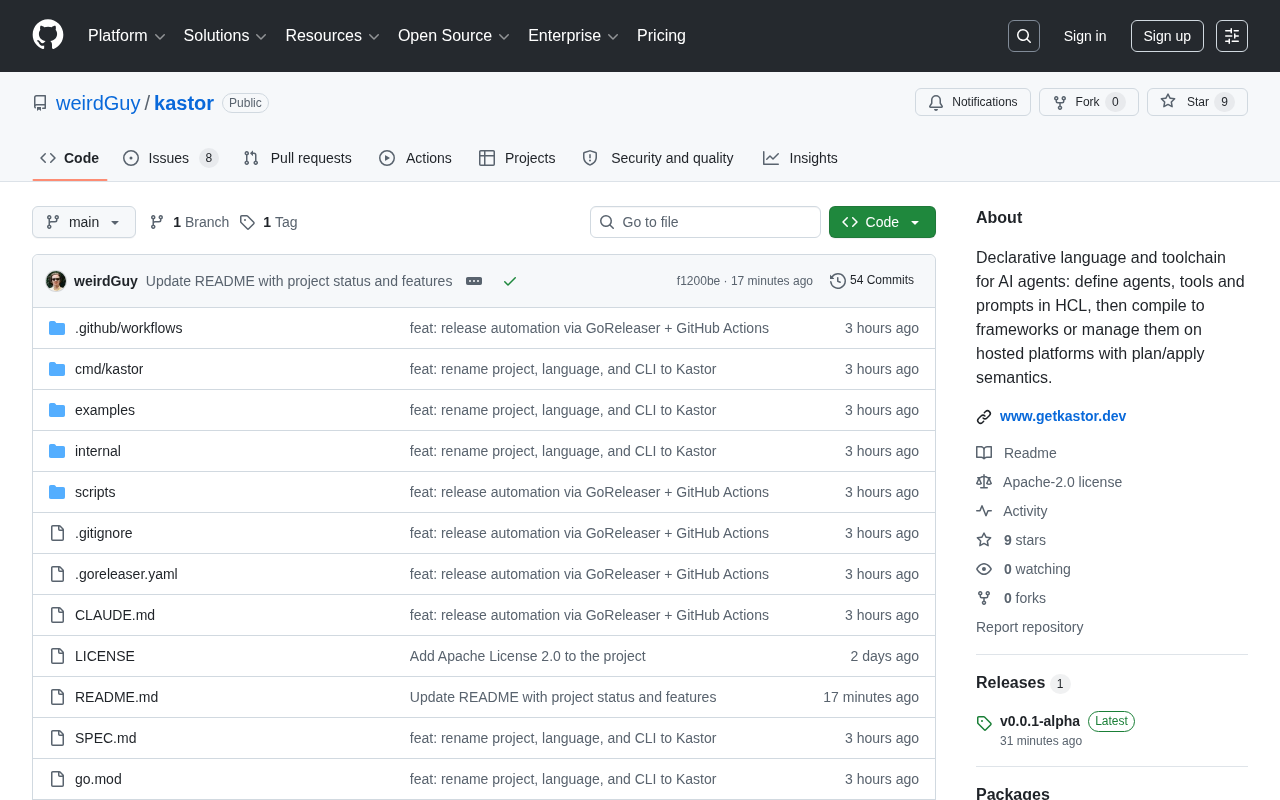
Kastor: A New Approach to Managing AI Agents with Declarative Specs
Kastor is an open-source project that brings IaC-style declarative specs to AI Agent management, inspired by Terraform — solving reproducibility, collaboration, and auditability challenges.
Read more →

·5 min
5 Things You Must Do Before Deploying AI Agents to Production (With a Banking POC Case Study)
Over 60% of AI Agent projects die between demo and production. This article breaks down Databricks lead Sandy's five-pillar methodology and a bank POC case study to help you avoid the most common deployment pitfalls.
Read more →

·6 min
Databricks Agent Framework in Practice: A Guide to ChatAgent Wrapping and Production Deployment
A deep dive into Databricks Agent Framework (Mosaic AI): unify LangGraph/OpenAI agents via ChatAgent, log & evaluate with MLflow, version with Unity Catalog, and deploy Model Serving Endpoints for production AI agents.
Read more →

·7 min
The Five Pillars of Production-Grade AI Agents: A Battle-Tested Guide from Demo to Deployment
Databricks tech lead Sandy shares a five-pillar framework for production-grade AI Agents—evaluation, observability, data foundation, orchestration, and governance—with a £85K retail banking failure case to bridge the demo-to-production gap.
Read more →